Militarism and Extractivism: The Case of Cyprus
Introduction
Extractivism - the unfair, harmful, and unsustainable exploitation of natural resources for capitalist profit - and militarism often go hand in hand. To increase their wealth and protect their profit interests, states and corporations often use violence and control (war, security and surveillance technologies, borders, political repression, etc.). The result of these policies of money-driven control and competition for resources is in plain sight: in addition to environmental harm, people and communities suffer from the consequences of displacement, austerity, and authoritarian governance.
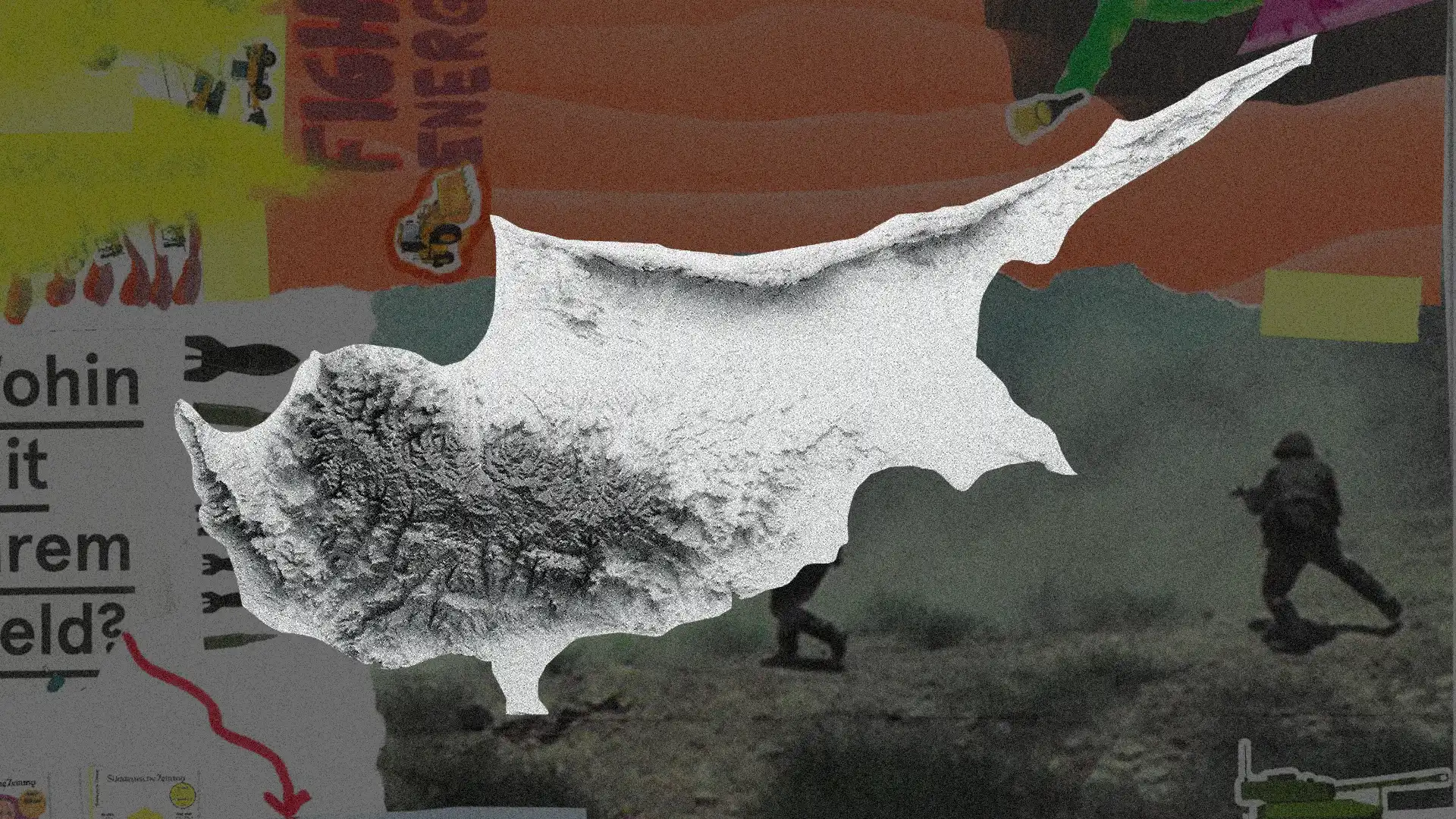
The case of Cyprus exemplifies this deep relationship between extractivism and militarism.
Following decades of British colonial rule, Cyprus gained its independence in 1960. The island is home to diverse Cypriot communities, mainly Greek-speaking and Turkish-speaking, among others. Since the time of independence, internal and regional power struggles have deeply impacted the lives of ordinary people in Cyprus. Internationally-enabled interventions of Greece and Türkiye, often under far-right rule, incited and reinforced ethno-nationalist conflicts within Cyprus, driving wedges between historically entangled communities.
Today, Cyprus is politically divided into the Republic of Cyprus (RoC), and the Turkish Republic of Northern Cyprus (TRNC). While the former is an internationally recognized state, the latter is only recognized by Türkiye, resulting in Lefkosia/Lefkoşa to be the only divided capital in the world today.
Militarization, ethno-nationalism, and authoritarian state control increased since the fossil gas discovery in Cyprus in 2010. To secure access, the RoC increased its security budget, which led to a rise in cuts in sectors like education and health. Moreover, the RoC is supported by foreign military powers and fossil companies. More recently, it is receiving support from Israel, supposedly to defend itself against Turkish aggression and expansion. Much of the mainstream nationalist discourse presents the energy policies as a move for national sovereignty and prosperity. While the Republic’s policies impact the Turkish-speaking Cypriots, who are collectively excluded from these decisions, more generally, the youth and the working class across the island have no say in decisions over resources, despite their impact on their lives.
The cost of all this affects people in Cyprus and beyond. Since the beginning of the ongoing genocide in Palestine, British bases on the island have been used to provide the Zionist entity with intelligence and military support. The island – its seas, its airspace, its land - is used as an infrastructure convenience in support of genocide. The military and intelligence cooperation deepened to the point that Israeli occupation soldiers use Cyprus for training and military exercises. The increase of military presence, in part due to enhanced security capacities, also directly impacts people on the move in the Mediterranean Sea, who already struggle to survive and live despite the violent and racist EU border regime. Those who oppose these policies are answered with state power – suppression of protest and rising police powers. This is a global trend.
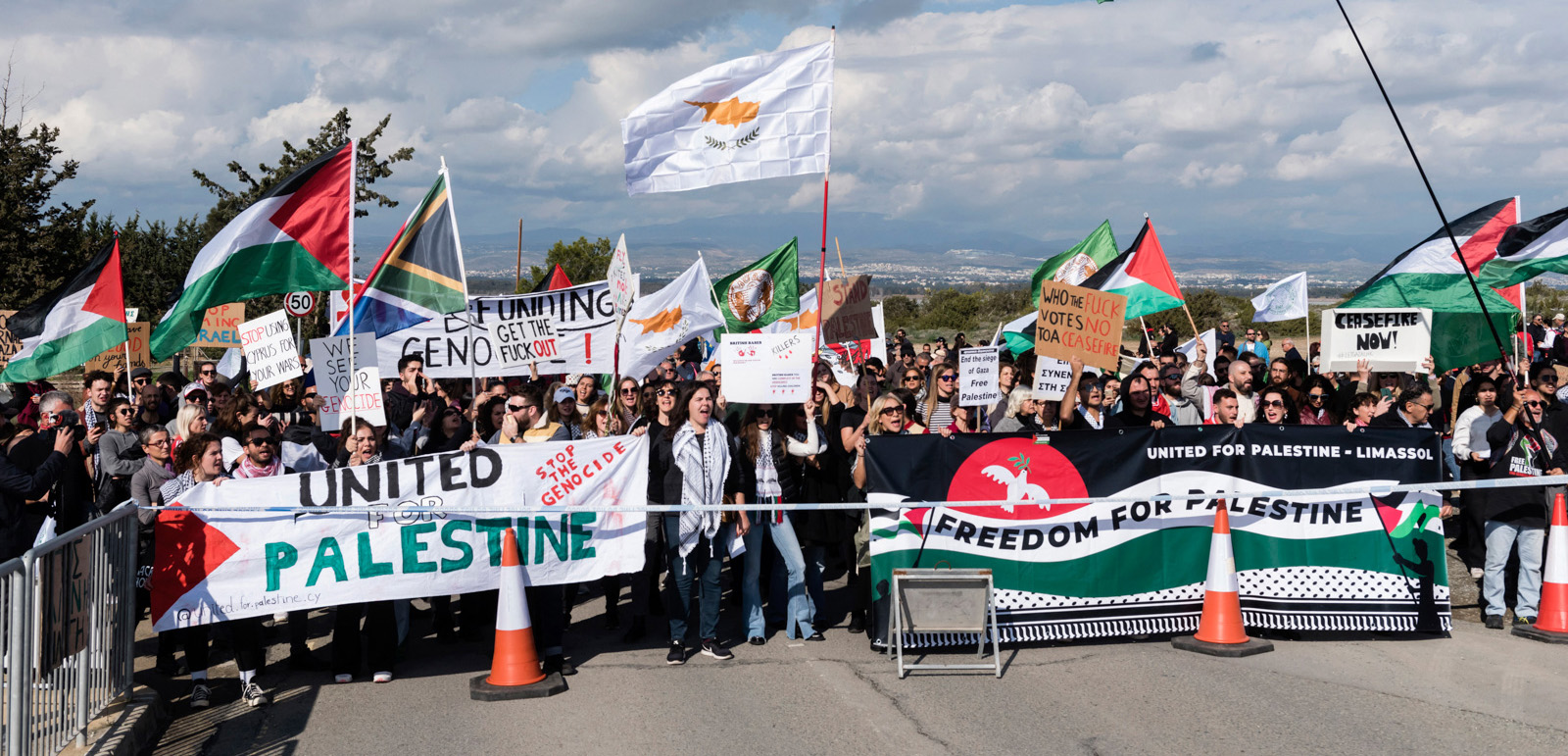
However, the people of Cyprus, across the divide, are resisting for a different system, as they fight for peace, equality, and unity for all on the island. This also makes the struggle for the unification of Cyprus an ecological cause against capitalism, neo-colonialism and imperialism.
Perspective
The following text was written by αφοα and was published in the WeSmellGas “Gas and Racial Capitalism” (2025) pamphlet.
Fossil fuel fields are often sites of contestation between countries as to who has the right to exploit them. Therefore, their extraction requires a military apparatus to act as a deterrent or engage in warfare.
The militarisation of land, sea and society is an important tool in the extraction of fossil fuels. Countries use their military capacity to secure access to resources, like fossil gas fields in the sea, and to prevent others - usually neighbouring countries - from doing the same. This often involves large-scale, organised and methodical violence against certain communities living nearby or other national armies. Indeed, this is often presented as a necessary strategy by politicians, to safeguard national interests and sovereignty over resources. However, the primary function of the military is to secure extraction and maintain racial capitalism, safeguarding the interests of private companies - making life more dangerous for marginalised communities on the ground in the process. This securitisation tool cannot be considered in isolation. Indeed, to secure fossil flows and develop necessary military capabilities, a few steps are required:
First, find the funding. States usually increase their arms budget by implementing welfare cuts and austerity policies. We witness this in the United Kingdom, where the Labour Prime Minister, Keir Starmer, simultaneously pledged to increase defence spending and cut welfare and disability benefits in 2025. To prepare for warfare the state works against welfare.
Second, build military alliances. States form blocks of geopolitical interests to share military resources and intelligence. Such alliances shift with geopolitical interests and often disregard international law.
A clear example is recent military alliances between Israel, Cyprus and Greece that meant extensive cooperation on military training and arms transfers. This enables and normalises the settler colonial occupation and ongoing genocide in Palestine.
Third, fuel nationalist rhetoric. To justify increased militarisation and normalise its presence, discourses of national security and external threats must be constructed. Once a national population is homogenised as having the same interests, an ‘enemy’ is constructed that threatens those interests. As such the need for militarisation is created. Whipped up by the state, this rhetoric often leads to increased fascism, anti-immigration sentiment and in worse cases, pogroms. For example, in Cyprus fossil gas and conflict with Türkiye over access to them, is used to fuel nationalist sentiment and justify militarisation.
It is the working class and marginalised populations that bear the costs of militarisation and militarised extraction. For example, since 2010 ordinary Cypriots have witnessed how new gas discoveries led to increased militarisation of their seas and multiple national armies on their lands: Israeli Offence Forces (IOF), French navy, Italian navy and Turkish warships. Why? Within Cyprus there is a long-standing sovereignty dispute between the Island’s two ethnic groups (Greek-speaking Cypriots and Turkish-speaking Cypriots), and more broadly Türkiye and Greece. As such, the Republic of Cyprus (RoC) sought ways to strengthen its hand against Türkiye, forming regional military alliances with Israel and enlisting support from the French and Italian navy to secure the corresponding national energy companies (Eni and Total-Energies) gas explorations. This meant that when Turkish warships often threatened the RoC’s gas exploration in ‘disputed waters’ several armies were ready to defend. The French and Italian navies sent warships to confront the Turkish army in the sea, as Cypriots across the Island feared a cold conflict thawing. This shows how private energy companies, particularly in contested spaces, heavily rely on a state's capacity to exercise mass surveillance, control and violence to extract undisturbed. In Cyprus, this means the prospect of reunification and peace is further and further away.
Similarly, it is Palestinians that bear the cost of increased energy and military cooperation between Cyprus and Israel since 2010. Despite Cypriots being historically supportive of the Palestinian struggle, recent geopolitical alliances with Israel have shifted RoC foreign policy towards Israel, an alliance presented as necessary to confront Turkish aggression. Since then, Israel has sold military ships to RoC, been granted access to its airspace and civil airports, docked jet fuel ships in ports, exported Israel’s Pegasus spyware to the EU and conducted joint military drills on land, sea and air. In conjunction, Israeli and RoC politicians discuss ‘priority’ energy deals on gas and electricity projects, creating further economic synergy with Israel. As the genocide in Palestine rages on, the rights, justice and life for Palestinians is sidelined in favour of economic deals with the settler colonial occupier. In Greek-speaking Cypriot society, many progressives have turned a blind-eye to gas exploration, and the consequential increasing militarisation, naively accepting the state narrative that fossil gas will bring the RoC energy sovereignty, economic strength and the Island reunification. Meanwhile, the opposite reality is true, as Turkish-speaking Cypriots are completely excluded from energy discussions and repression against activists fighting for environmental justice and Palestinian liberation escalates daily.
Beyond this another population who bears the cost of militarisation in the Eastern Mediterranean are those fleeing Syrian and Lebanese shores to reach the Republic of Cyprus, EU soil. The increased militarisation of gas and the sea, means an enhanced state capacity to surveil the oceans and the people trying to cross it. This leads to increased violent pushbacks, pullbacks and deaths at sea. Militarisation and nationalism make the lives of people on the move expendable as the hegemonic discourse frames them as a threat to national security.
Resources
- The αφοα Μedia Project shares content, news, articles, reels and sometimes podcasts centered on anti-fascism, social and environmental justice, and anti-imperialism in Cyprus. Podcasts feature interviews with activists and thinkers who explore struggles in Palestine, anti-racism, and resistance against authoritarianism. Content often highlights grassroots organizing and solidarity efforts, aiming to educate the audience on current political issues from a leftist, anti-colonial perspective. Languages used are Cypriot Greek, Greek, and English interchangeably. The podcast is in Greek. You can follow them on Facebook, Instagram, and YouTube.
- In this intervention at the WeSmellGas Day School in London (July 2025), αφοα gives an overview on militarism and extractivism. αφοα talks about the consequences of the competition over resource extraction in Cyprus: militarisation, austerity, and political repression, before describing the ways in which people in the island resist oppression and environmental destruction.
- Here is a visual essay by London-based artist Ayshe-Mira Yashin about Akrotiri and Dhekelia, the British Sovereign Base Areas (SBAs) in Cyprus. It documents the Royal Armed Forces’ use of bases in Cyprus for the duration of the artist’s visit during the genocide in Gaza. The artist, whose heritage includes roots in Cyprus, centers her practice on themes around occupation, land, and ecology from feminist and mythological perspectives. You can find Ayshe-Mira at @ayshemira on Instagram.

- Gas and Racial Capitalism (Pamphlet) by WeSmellGas, with the Militarisation chapter written by αφοα. Overall, this pamphlet is designed to help comrades across movements understand why thinking about energy - specifically fossil gas - and racial capitalism together is important, and demonstrate how they materially work in tandem. It takes us through different tools of racial capitalism: sacrifice zones, borders, militarisation, policing, cheap labour, colonial debt, fascist rhetoric, and shows how they interact with and reinforce gas expansion.
Dive deeper
Groups to follow/check out
- Far Right Watch, an information page, deconstructing the far-right rhetoric that has flooded public debate.
- HADE is an intercommunal initiative promoting peace and reconciliation in Cyprus by organising events, and actions.
- Genocide Free Cyprus is a platform that is uniting, advocating and spreading awareness for a #genocidefree world, by sharing research, information and taking actions.
- Bases Off Cyprus, a coalition of groups across the UK, Cyprus and US taking action against the colonial bases occupying the island, compiled a list of resources (articles, videos, books, etc.) useful for campaigners.
Books/articles
- Environmental protection and cooperation in an (ethnically) divided island: The case of Cyprus (available in greek & english)
- 8 Female Activists in Cyprus Standing up for Environmental Justice (available in english)
- The Normalisation of Cyprus’ Partition Among Greek Cypriots (available in greek & turkish)
Movies
- Tongue: Tracing the life of activist Costis Achniotis, the film develops within the history of the Cypriot radical Left and the bicommunal movement for reunification. In parallel quests between the past and present and with an auto-ethnographic approach, the filmmakers bring together personal artifacts, new and archival material, exploring the dialectics and poetics of the ethnic clash and division in Cyprus. (available in cypriot greek & cypriot turkish, with english subtitles)
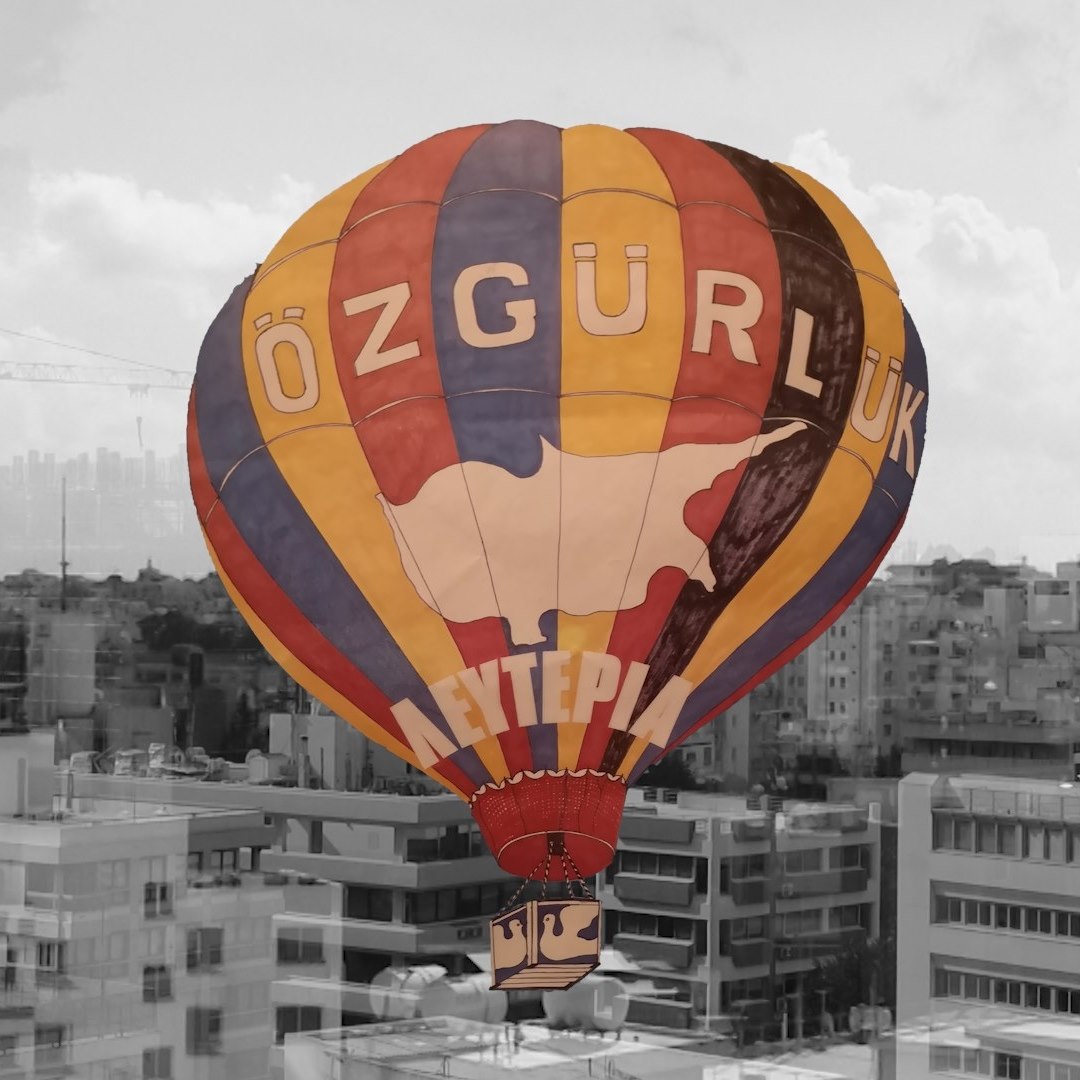
- CODE82: Documentary by Mine Balman. Since late 2020, at least 15 Turkish speaking Cypriots have been denied entry to Türkiye, where authorities describe them as "a national threat".
- The divided island: 2024 marked 60 years since the violence that divided the island of Cyprus. The Divided Island brings the 'Cyprus problem' back into focus, revealing untold stories and unraveling the intricate history that still reverberates today.
- The Third Motherland: What does it mean to belong to a motherland? How does it feel to be caught in-between different motherlands? What burdens but also what rights and opportunities does belonging to an "other" motherland entail? How does ethnic conflict exacerbate identity problems and impact on the cultural heritage of small minority communities? Filmed in Cyprus and Lebanon, The Third Motherland addresses these questions by following the story of the Cypriot Maronite community. This is a film about cultural loss, co-option, denial of rights and everyday social problems, but also of ethnic pride, cultural revival, communal joy and resistance. (available in cypriot greek cypriot arabic and english, with english & greek subtitles)
Who is fighting?
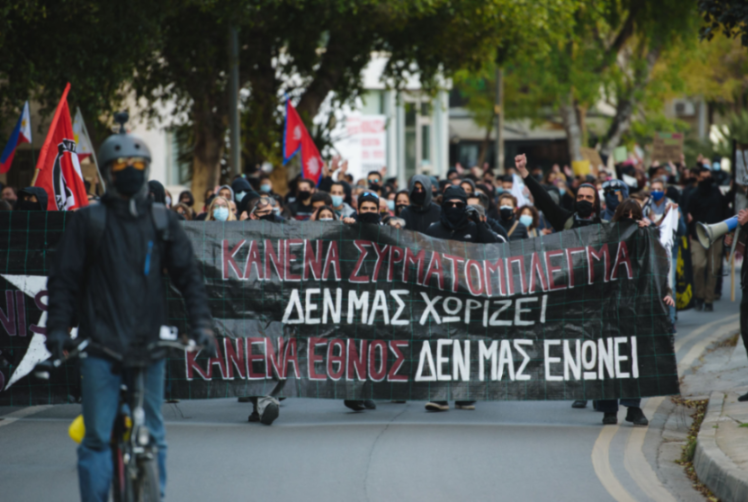
Across the divide, people organise towards the reunification of Cyprus and against militarisation, extractivism, and imperialist intervention. Different organizations in Cyprus resist the occupation of the island and the extraction of its resources for foreign or elite interests. These include αφοα, Genocide-Free Cyprus, Bases Off Cyprus, Far Right Watch Cyprus, and United For Palestine collectives across Nicosia, Limassol, Larnaca and Paphos. Some of these groups are part of No Harbour for Genocide, a Palestinian-led coalition of grassroots groups coordinating actions across the Mediterranean trade routes to disrupt energy flows and military equipment to Israel.
People all over the island are also taking part in demilitarization campaigns. Among them are conscientious objectors who refuse to join any army, struggling for a united island based on peace, mutual understanding, equality, and freedom. Here is a joint declaration by the Association of Greek Conscientious Objectors, Conscientious Objection Watch (Vicdani Ret İzleme) and the Initiative for Conscientious Objection in Cyprus (Kıbrıs’ta Vicdani Ret), on the occasion of the International Day Of Peace 2024, titled “We Are Resisting For A World Without Wars”.
Many anti-militarist activists face trials and jail sentences for their positions. In this Turkish-language short film from 2021, you can find out more on conscientious objection in northern part of Cyprus. It includes interviews with activists, as well as representatives of political parties opposing their aims. It features Halil Karapaşaoğlu, a Turkish speaking Cypriot academic and prominent activist who has faced prison sentences for his work. You can hear his perspective in English in this short portrait. One ongoing struggle is the case of conscientious objector Hasan Rahvancıoğlu, who is facing a potential prison sentence in the northern part of Cyprus.
In this article, members of Avli, a social justice platform in Cyprus with a focus on the environment, presented their stance on the topic of militarism and forced conscription. Among other things, they spoke about how these reproduce heteropatriarchal norms and nationalist sentiments, in addition to the ecological costs of war and militarization. The post includes testimonies from across Cyprus by people who have been recognised or have applied to be recognized as conscientious objectors.
Solidarity
17/01/2026 Solidarity with Hasan and with all conscientious objectors
We are here today in solidarity with Hasan and with all conscientious objectors, from both sides of the divide.
At a time when war has become part of everyday life — in Cyprus and across the world — we stand with those who refuse to kill or be killed for the profits of the powerful.
The wars we see around us are not accidents. They are the result of decisions taken by ruling elites who believe they can sacrifice lives in order to protect their interests and maximise their profits.
Here in Cyprus, both the north and the south are rearming in the name of “security”. Our island — once called an “unsinkable battleship” by its colonisers — is being turned again into a military base. Weapons are piling up, foreign armies and warships surround us, and natural gas is used as an excuse for militarisation.
At the same time, fear is being cultivated everywhere. From Palestine to Ukraine, from Lebanon to Sudan, wars multiply. NATO and the major powers demand ever-increasing military budgets, while Europe prepares for war, reintroduces conscription, and normalises militarism.
Billions are spent on weapons, while people struggle to survive.
They talk about security — but their security is built on our sacrifices. They ask for our sons and daughters to feed their war machines. All the propaganda about security is used to justify the “Rearm Europe” programme, presented to the European Parliament and approved in March 2025. This programme foresees 800 billion euros in spending on EU “defense”, primarily for the production and purchase of advanced weapons systems.
That is why we say: enough.
Standing with Hasan means standing for the right to say NO:
No to killing,
No to militarisation,
No to being used as fuel for war machines.
We stand with conscientious objectors in the north and the south. And we say clearly: we need a strong, united, anti-militarist and anti-war movement.
A movement that demands:
money for social needs, not weapons;
jobs, wages, pensions and housing, not militarisation;
health, education and the environment, not war profits.
This system is in crisis — a system that puts profit above human life.
That is why we say NO to militarism and armaments, the capitalists and their system.
And YES to social justice, peace, and struggle from below, for another society.