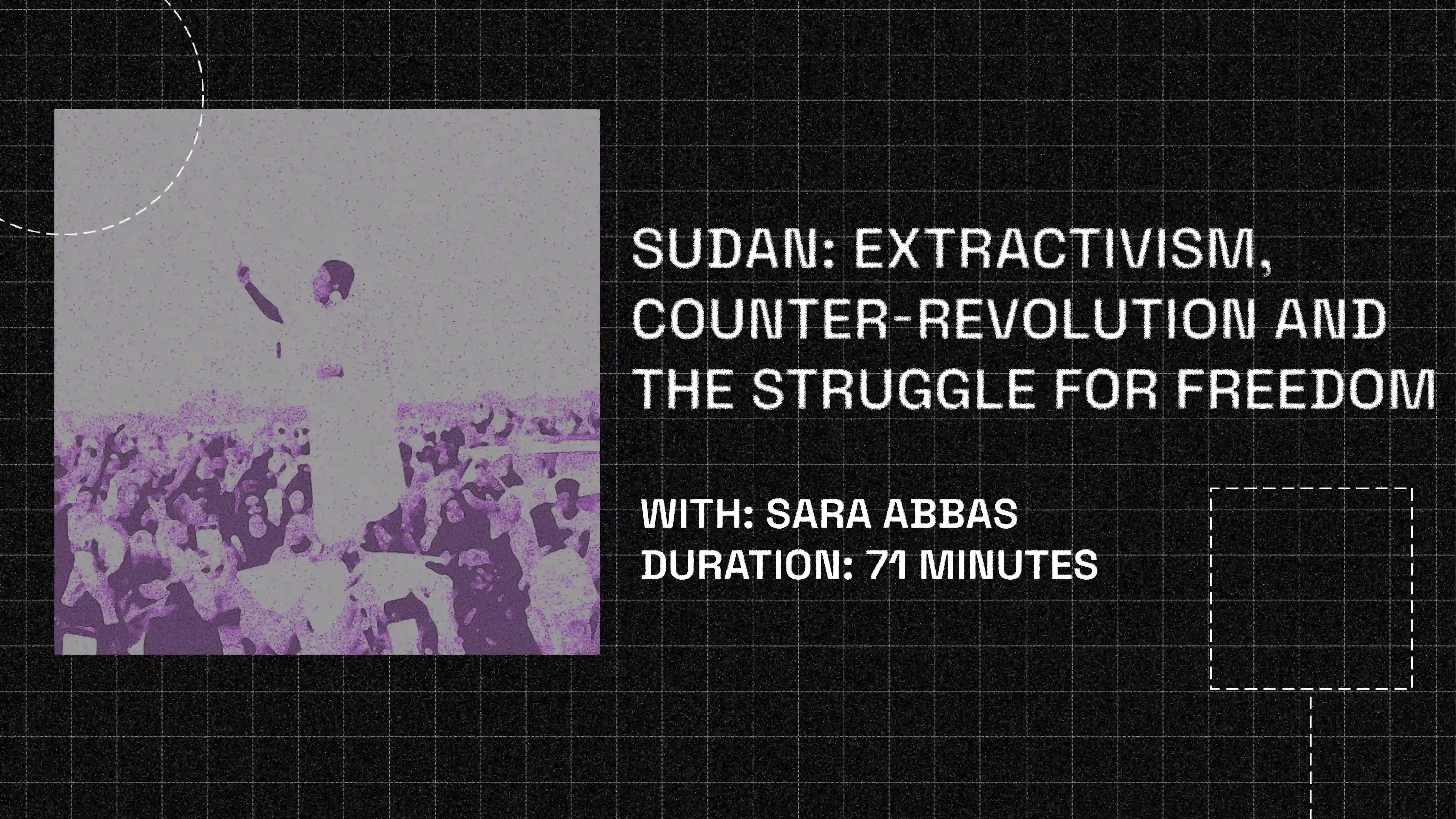
Sudan: Extractivism, Counter-Revolution and the Struggle for Freedom
PLATFORMS
On RSS
On Pocket Casts
CONVERSATION SERIES
Listen to organisers and thinkers sharing their experiences and perspectives. Focusing on struggles and learnings crucial for our social movements at this time, these in-depth exchanges allow you to discover new topics and dive deeper into what matters.
ABOUT THIS EPISODE
This podcast episode is an interview led by WesSmellGas with researcher and activist Sara Abbas. It offers an account of the situation in Sudan, before, during and after the 2018-2019 uprising. In the aftermath of the escalation of violence in El Fasher in late 2025, thousands of people in Sudan have been subjected to mass killing and forced displacement, in addition to sexual violence. To many of the people who took part in the recent uprisings, this is nothing less than a counter-revolutionary war aimed to further racial capitalist interests and suppress people's freedom dreams. This episide not only focuses on the recent violence and destruction which affects the broader region, but also amplifies the resistance of people in Sudan, past and present.
SPEAKERS
Sara Abbas is a researcher of gender, the state, and social movements, with a focus on Sudan. Since April 2023, she has focused on supporting feminist groups and mutual aid networks to resource themselves in their fight against the war and for the survival of their communities. Her writing on Sudan over the past years includes a contribution to "Diversity on Common Ground: Ten Perspectives on Modern Feminism", and the essay "The Weight of Feelings: Khartoum's Revolutionary Movement". Sara is a fellow of Decolonize Now! working on a project documenting feminist narratives against the war, and how they generate, sustain, and renew themselves in the face of catastrophic sexual violence and genocide.
MUSIC
- Surrender سلم مفاتيح البلد – Zoozitaزوزيتا (here) -
- (here) لونها لون تاجا- سمرة افريقية
- سودان بدون كيزان Sudan Bidon-Kizan – A.G. (here)
- Ahal Al Amar – Esaam Satti X Ali Naseraldeen (here)
- ليلك جنّ – Sulaf Elyas سلاف الياس
- (here) ثورة وعي من أجمل الأغاني الثورية السودانية
RESOURCES
- The Weight of Feelings: Khartoum's Revolutionary Movement
- War in Sudan and Women's Resistance (Podcast)
- In Sudan, the Revolution Is Caught in the Crossfire
- The Sudanese Revolution’s Second Act
All related resources and much more can be found on the Resource Library. This is a digital multi-media library to share resources on energy, extractivism, imperialism and collective liberation.
TRANSCRIPT
INTRODUCTION
WSG: Welcome to "Sudan: Extractivism, Counter-Revolution and the Struggle for Freedom" - a podcast episode by WeSmellGas Collective.
This podcast episode with Sara Abbas was recorded in January 2026. It will not only focus on the recent violence and destruction, but also amplify the resistance of people in Sudan, before, during and after the 2018-2019 uprising.
Sara Abbas is a researcher of gender, the state, and social movements, with a focus on Sudan. Since April 2023, she has focused on supporting feminist groups and mutual aid networks to resource themselves in their fight against the war and for the survival of their communities. Her writing on Sudan over the past years includes a contribution to "Diversity on Common Ground: Ten Perspectives on Modern Feminism", and the essay "The Weight of Feelings: Khartoum's Revolutionary Movement". Sara is a fellow of Decolonize Now! working on a project documenting feminist narratives against the war, and how they generate, sustain, and renew themselves in the face of catastrophic sexual violence and genocide.
We decided to make an episode on Sudan in the aftermath of the escalation of counter-revolutionary violence in El Fasher in late 2025, where thousands of people were subjected to mass killing and forced displacement, in addition to sexual violence. With grief and anger, we observed how the events have been largely overlooked in the media. In many ways, this is due to geopolitical interests dominating the media landscape in many parts of the world. However, this situation also reveals much about anti-African, anti-Black racism, as well as Euro-centrism on the left.
This episode does not only aim to draw attention to recent events, which have unfolding consequences for Sudanese people as well as the wider region, but to contextualize them within global systems of oppression. We want to understand how organizers and ordinary people have been and are navigating the counter-revolutionary war, the growing armament and militarization, and the efforts to unite and work for change and justice.
It is important to understand Sudan's historic place in the region, its revolutionary traditions, popular demands of revolution and the subsequent counter-revolution, as well as the country’s place in regional and global systems. We believe that it is our collective duty to educate ourselves and each other about Sudan and all other places impacted by imperialist and militarist power.
What lessons should ecological and anti-imperialist movements take from Sudanese organizing? And what does solidarity mean? What would it look like to center Sudan in internationalist practice, and in global struggles against extractivism and militarism? How can especially environmental activists place Sudan’s experience into the broader fight against resource colonialism?
INTERVIEW
WSG: So I would say the first question, Sara, is starting from this historical perspective and from your personal experience, how did you experience the 2019 revolution? What forms of organizing did you and others build during this period of time and also in its aftermath?
Sara: I experienced 2019, or 2018 actually - because what we call the 'December Revolution' in Sudan started in December of 2018 - as it started out with some protests that were in cities outside Khartoum, including Damazin in Blue Nile State, Atbara. And then from there, it's really built up steam really fast that I would say that by mid-January, there were protests in every corner of the country at that time.
So just as a background for people that don't know much about Sudan - it's kind of difficult to give a background because sometimes when you're talking about certain places, people not from that place have a bit of a background. Often with Sudan, that's not the case. So it's a little bit tricky - but just very briefly, Sudan gained its independence in 1956. But already from 1958, or in 1958, so two years, into the so-called post-independence period, there was the first military coup. And from that point on, the history of the country was characterized by very, very long periods of military coups - so military regimes that come to power through coup d' états that seize power, and then civil uprisings, sometimes called 'revolution', sometimes called 'intifada' - we can talk about it, I think, at some point, a bit more - but essentially, civic organizing that then topples the military regime. We have very short, often, periods of what we would call what you would call 'multi-party democracy'. That's also a term that's very complicated, I think, but essentially a period where there are elections, at least in most of the country. And then you have certain political parties that are ruling the country. And then there's another military coup that goes into a period of military regimes that are then toppled again. So there is a kind of cyclical nature to this history. By far the biggest political actor in Sudan since 1956 has been the military. So I think this is something that people in Algeria, I would say, and in some other contexts would relate to - that the military is the key political actor.
The other element of that history is that Sudan is an extremely ethnically diverse country. It's religiously diverse. It's diverse in its geography up until the independence of South Sudan - so basically the split of the country into two in 2011 - it was the biggest also country geographically on the continent of Africa.
And beyond the military coups and civic uprisings dynamic, the other related dynamic is war, essentially. As far as I can remember, - and I'm 47 years old-, but I know also from already prior to independence, there were always uprisings in different parts of the country, what were called by the colonial regime as 'peripheral country areas' or 'marginalized areas'. And the post-independence governments, whether civilian or military, they maintain that colonial kind of framework of looking at these diverse regions as sites of extraction. So places where you extract the resources, but you give nothing back. You don't let the people keep any of the resources, but also they tend to be areas that are extremely disempowered politically and very, very, very impoverished. I don't say 'poor' because nobody is poor. People are made poor, right? So basically, those areas are also racialized historically, you know, so Darfur, South Sudan, Blue Nile, South Kordofan, those areas are racialized sites of extraction. So there are areas where you see kind of racial capitalism and racial colonialism operate in a certain way. This of course has led to conflict and the state has very brutally worked to keep its extractive apparatus functional there and also to assert the power of the center of the country - so Khartoum, Jazira and other places - basically by state violence against those regions. And so that's the other dynamic.
South Sudan, as known - if you'd read an article about Sudan in the 1990s, they would say Africa's longest civil war.
So I'm sorry to kind of go back a step, but I think it's extremely hard to understand the revolution if you don't understand this history.
And so when the revolution of 2018 started, it was obviously building up on a lot of these histories of dispossession, of political marginalization, of racialization, of racial capitalism and extraction, of colonialism. And I think it's interesting in relation to this revolution that it did not start in Khartoum, which is typically where historically, - at least that's how the history is written - that's where the civic uprisings usually started.
It actually started in some of these areas of extraction, like, for example, at the Damazin in Blue Nile. And actually, they started initially as protests about, you know, by students and also just by people in those communities that were protesting the price of bread. So they were called in the beginning in the Western media 'bread riots'. But of course, I mean, bread is quite a central thing because it's a staple food for Sudanese people, but it started to attract a lot of grievance among a lot of different segments of society, so that two months later, it had gone to the capital, it had spread into multiple cities, even some rural areas, and it had also started to become about the fall of the regime very, very quickly.
And that regime had been in place for 30 years. It was a regime that called itself an 'Islamic' state. So it was an alliance between the 'Islamist movement' in Sudan, which is the name that we give to what historically started as the Muslim Brotherhood, allied with the military. And they have ruled for 30 years. And up until that point, the level of brutality that we experienced was never worse than during those 30 years.
And so I experienced this mainly as a diaspora Sudanese, and I became a diaspora Sudanese in the early 90s as a child, I think when we left Sudan I was 12 years old. I'd always been involved somehow in the struggles in Sudan, even in the years we could not go back because I grew up around the struggles, the earlier uprisings, and I grew up around people who were unionists and worked in the unions and were resisting the military dictatorships at the time and being jailed and so forth. So I had that particular background, which meant that as I grew up, even when I was supposedly safer, we always lived with this thought that we wanted to be free.
I don't think that people in other struggles, or many people in other struggles, realize what a terrain of organizing the Sudanese revolution was. As someone who takes a lot of interest and learns a lot from other struggles elsewhere, I can say that it was definitely one of the most sustained uprisings globally.
So it began in December 2018. It's always easier when you're talking about this to talk about when it began and much harder to talk about when it ended. But it was really the height of the organizing, the height of this revolution. And I use the word 'revolution'. This comes up a lot like, you know: "Is it a revolution? Or is it not a revolution?" I've kind of learned not to worry about that. I'm using the term that the people that were doing this uprising were using - so, they called it the 'December Revolution'. And it was sustained through 2019 in the face of a lot of brutality, and it was sustained further, even when there was a deal that was reached between the political elites and the military regime.
It was sustained into 2020, into 2021 when the military mounted another coup d'état and took over, and that actually in 2022 and 2023 up until this was started, there was a massive organizing.
So as a person in the diaspora - and diaspora is a very loose word, I think you have all sorts in the diaspora - the way that I saw my role and the groups that I organized with, we saw ourselves as extensions of the revolutionary currents within the uprising because they were different currents within the uprisings. They were more reformist currents and they were more radical currents and so forth. So we saw ourselves as extensions. And when I say extensions, it meant that at no point did we see that we, for example, would be the ones to come from the outside and kind of lead the people. Because you see that in Iran now with the monarchists and so forth, you saw that after the invasion of Afghanistan: there are currents within the diaspora that I think are just imperialist stooges. But the main point is that our job was to on the one hand, to try to protect this revolution from the attack from the outside.
So, for example, some of the work that I was involved with relates to borders and particularly related to the role of the European Union in the dictatorship. Because the European Union's role is really ugly and most Europeans either don't realize that or they don't see it as relevant to them, but essentially Europe's migration agenda, anti-migration agenda, it's externalized borders are created or they helped set the ground for a lot of this violence that was being exerted, including that the main group, the Rapid Support Forces that was being used to suppress protests in the urban center started out as border guards under an EU regime. So that was one very clear thing that we could see that we needed to work with.
Another area was to support migrants and refugees that were coming - not just from Sudan, but Sudan hosts millions of migrants from the region, whether it's Ethiopia or Eritrea, which are the two biggest countries, South Sudan and other places. So that was another aspect of it that I was organizing.
And then the other, the thirdm was to try to link up this movement to other movements elsewhere. So essentially, trying to basically work within a more like internationalist framework rather than within these nation-states borders, because we saw, I saw, the people that I organized with, we see ourselves as a part of that wider internationalist or internationalism from below current, and that we know that we cannot succeed if others don't succeed. So that was also like building solidarity was I would say a lot of the work.
So it was everything from organizing protest events to talks to sit-ins to writing, speaking, going to meetings, political meetings of other groups. So that's kind of how I experienced it.
I gave all the kind of practical things, but I think you experience revolutions emotionally as well. And so we also experienced it. It was, it was a really, really difficult time, especially I think around June 2019, when the sit-in in Khartoum and in 13 other cities was suppressed brutally. Because so many people died in this uprising, and so many people lost their lives and so you experience it as well emotionally. There's always a sense of guilt but I think the difference between kind of sitting there and feeling guilt is that you know we see that we have a role and so that was how I experienced it.
WSG: How would you frame the recent developments in the country, how would you frame this counter-revolution that we're talking about? And how is it important right now to sustain the revolutionary part of organizing?
Sara: Here's where it gets very hard because about three months before this war started - and I say "this war" because people like myself, I come from Khartoum, people like myself who come from the center, the kind of Arab Muslim center of the country, historically have not... I mean, there was always uprisings and protests, but they've never really experienced the overwhelming violence that people in the so-called peripheral areas of the country have experienced. They've experienced it indirectly over decades and decades, with the destruction of rural lives under this extractive capitalist alliance between Sudanese capital and the state and international capital. What that did is it destroyed rural livelihoods and moved the country into, in a more pure way, extractive economy around oil and gold eventually. So farming, especially - traditionally or historically, most Sudanese people come from either farming or pastoralist herding communities. And so with the destruction of their lives and the kind of war against certain regions of the country, many people were displaced in earlier wars and ended up in Khartoum. I mean from my time as a little child to now - well, not now because the war has emptied out the city again - but up until this war, the city had swelled and become so huge with huge belts around it of essentially people who are extremely dispossessed and who have been forced into an urban informal economy in search of safety, in search of just being able to live, really.
And so, we always have to be careful, I think, when you listen to people in Sudan, because it feels to certain people who - I'm the third generation from Khartoum - that it seems like it's never happened before. But I think in a way it was inevitable that you can't have a country that's burning everywhere and the center stays pristine. Like, you know, violence will find you. And I think this is one of the lessons - I'm already talking about lessons -, but whether it's in the US abd what's happening with ICE, or whether it is in Iran, whether it's in Sudan or Palestine, if you think that you will be safe while others are unsafe, you are mistaken. And this is borne out by history.
So I think in terms of this specific war, what is a fact is that the scale of this war is unprecedented. So this war has not just engulfed the whole country, but it has also spilled over across the border. So one of the things that we're dealing with right now in our region is that people have nowhere to run. I mean, we had so many people from Tigray for example, that had taken refuge in Sudan. You have people from South Sudan that have taken refuge in Sudan. You have Darfurians from Sudan that had taken refuge in Chad. And you're in a situation where people are literally in some parts of the border running across the border because neither place is safe. And so it's a regional issue. It's not just a Sudanese issue.
But what I wanted to say was that one very interesting and important thing is: you'll often hear about Sudan talked about in two ways. I'm talking about in the sort of English language social media at least that I am familiar with. One way is that it's a 'forgotten crisis' and sort of that's picking up on a lot of the discourses about, you know, 'starving Africans' and 'poor Africans', but the reality is those discourses live within actually a complete dehumanization of Black and African lives . I'm not even going to go to Ukraine but it's almost taken for granted that Black African people are born to die, to labor and die. But besides this forgotten crisis narrative, the other narrative, which activists really, very well-intentioned people - I've even sometimes used that phrase myself -, but increasingly over the last three years, we started to use the term 'proxy war' about Sudan. And I think it is a proxy war, because when you look at Sudan, in the same way that you would look at Syria, you know, this is not an internal affair. Every single party to this violence is being backed and supported by an incredible amount of logistical surveillance, weaponry, from the outside, as well as from powers that are involved in this conflict that have stakes in it. But also, you find that the same powers are extracting especially gold in the case of Sudan. So the vast majority of Sudan's gold is smuggled out of the country. So it is a proxy war. But I think the proxy war narrative, as mobilizing as it is, I think it hides the fact that it's not actually, or in reality, really only about this proxy politics. Because I think the proxy war narrative implies that if you were able to get these powers out, everything would be okay. And I don't think so. I think there's a history of dispossession internally. I think there is a history of repression. And I think that that makes it a much more complicated thing. I think there's also a history of revolution.
And so three months or almost, even less, about three months, mid-January of 2023, three months almost exactly of when this war started, the resistance committees, which are like the biggest organizing actors in the country - and there's thousands of these committees that have sprung up from 2013, but this number really exploded in the revolution - they were leading, especially from August and June 2019 on, organizing their decentralized network, mostly younger people who worked initially underground at different points underground but really organized the resistance. And they had done an incredible amount of work in the year before to come up with a unified charter that was based on really in-depth work, organizing work in most of the states in Sudan. And so they had finally released their compromise charter and it was kind of like a blueprint, almost a constitution of the movement. And so myself, Rabab al-Naiem, and Nesrine Omar, we've written about this, pushing back against this pure lens of "proxy" because we see it as a counter-revolutionary war more than anything, because the revolution was not successful in the sense that it was able to really turn. It was able to bring down Omar al-Bashir, but it was not able to bring down the military state. But it was also not able to be killed. It was continuing to actually move from the protest politics into the organization of a vision for the future. So I think it was starting to disrupt the extractive machine. And it's not a surprise that in a way - and that's one thing we didn't anticipate - that the level of the violence has really fractured the movement because we're in a situation where your main form of organizing is based on the local thing and on the streets. So owning the streets in a way, you know, as a movement, and organizing locally by name of it, because that's what the resistance communities do. And then they network across neighborhoods, across states and then across the country.
And so what this war did is that it destroyed the place. It destroyed the ability of people to be on the street because of the overwhelming violence. It destroyed their ability to remain in their own homes. And so it scattered, it broke these local organizing bodies by virtue of flinging people anywhere where they would go to be safe. And I can talk a little bit, at some point, about what remains of this movement.
But the reality is - anything I'm saying from this point on is - there's no unity on the analysis. In the way that at least in the earlier parts of the revolution there was. There was a very clear thing: we need to bring down the fall of the regime, we need to move the military out of politics, we need to disband the militias, and we need to regain control of our resources and direct them towards health and education and all of this. So I would say that the proxy war narrative... Sudanese activists have been partly been pushed into this narrative - this is very controversial, but this is my analysis - of the Palestine model. Sometimes I think the way that we, as activists, treat wars that are internal (meaning that you don't have the Israelis against the Palestinians) almost like domestic violence, if I can bring my feminism in. So as long as it's within a border, it's a civil war. These people are doing it to themselves. But of course, wars are never that, right? Whether it's inside a border or spilling across a border. Wars are always about capital, about capital moving across borders. And so it doesn't matter, I think, if it's internal or external.
I think countries like Sudan and countries like Iran are colonized, they are just colonized by their own states so regions of them - when you go to certain regions of Sudan -, they are militarily colonized. So I think we need to deepen our analysis a little bit and really start to use different terms.
The reason why the proxy war narrative is important is because the United Arab Emirates especially - it's not the only actor - but it's benefiting overwhelmingly from Sudan. And it historically benefits from land grabbing. Many of the Gulf countries are grabbing land that have vast areas of the country's agricultural land that they control. But they're also benefiting because about 80 to 90 % of our gold goes into the UAE, which does not have gold. And that gold, at least 80% of it, is smuggled out. And so, it's benefiting very materially from this.
And that means that it is invested in supporting the RSF and basically keeping control of that region. And you have everyone in there. You have Russia, you have Turkey, you have Iran, you have the United States, from a slight distance, but still there. You have the European Union with its border policy. So this is a proxy war, but it is more than a proxy war. It's a counter-revolutionary war, first and foremost.
WSG: Amazing, thank you so much. It's very interesting to link it also to a lot of the learnings from all of this and how to link it also to other struggles. I'd like to just maybe go back a little bit to the resistance committees, as we cannot talk about them enough also. I was wondering exactly on the feminist organizing of these committees, if you could say a bit more about this. How was it organized or what can you say about those forms of organizing or that lens that you already brought in? And also the emergency rooms and all these response emergency response rooms that are happening all across Sudan right now.
Sara: There's a really rich history of organizing in Sudan, because you have both actually, armed and non-armed histories of organizing. So you do also have people who have picked up weapons against the state. They tend to be organized more regionally and they tended to be organized historically more along ethnic or regional lines. And then you have the history of civic uprisings. So, in 1964 we had the first major civic uprising in Sudan that brought down the military dictatorship of Abboud at the time. And that was mainly a coalition of unions and students and activists and women's groups that had come together to bring this regime down through protest and through organizing, in unions and in bodies of the professions and the trades.
And in 1969, another military regime came to power, the Nimeiri regime, and that regime stayed in power until 1985. So one of my earliest memories of politics was what we call the Intifada of 1985, which brought down the military regime of Nimeiri. And actually, historically, those uprisings were always led by the unions and the students and so forth.
What was really interesting about this, in my lifetime, of this revolution is that it kind of began in a very similar way. So there were protests, in which then some of the professional bodies (called the SPA), the Sudanese Professional Association, they were leading them in the beginning. But then you saw this moment in April, where the class position comes out, where you start to see the SPA and the political parties negotiate with the military, which is something that on the street level people were not most people were not okay with because they were literally occupying like half the city at that point.
And I think what's interesting is that, in 2013, we had a smaller uprising in Khartoum. And it was a really brutal one. In a few days, they killed hundreds of people and they detained so many people. And that is the kind of core of when the resistance communities formed, because the earlier committees - usually when I like talk to them -, they would say the earliest communities, actually one of the earliest ones, was in the area where I grew up in Khartoum. They began at that time working underground. And in some of the beginnings, people were just very determined that they were going to keep the memory of the martyrs, the people who were killed in the uprising alive. And then it evolved from there. But in the beginning, the resistance committees were few and taking a backseat to the professionals.
After April and May, and then in June, for sure, because the resistance committees at that point, there were so many that had formed across the country. And they were the ones running on the ground, the organizing. If you're occupying a space where you have 70,000 people, you have to feed them, you have to have education, you have to have security. So they were doing a lot of that work. And then when the sit-in got repressed and the internet collapsed, which is what a lot of the kind of political groups were using, the resistance committees really stepped up. Because they were at the neighborhood level, they were able to organize on the ground, not just on the internet. I remember the 30th of June, after the suppression of the sit-in, one of the main ways people knew that on June 30th, everyone was going to go out on the street was walls, writing on the walls, for example. That was the neighborhood-level work.
But in terms of your question, I mean, these are patriarchal structures still, right? So you often find that women activists are fighting on multiple fronts. So they're fighting and the big fight against whatever. But their big fight is also within the organizing spaces themselves. So there were always more men than women within these committees. I could talk for days about that because that's a feature of politics in general in Sudan. For example, often people will organize at night in the houses. And so it's very hard for girls to be able to leave the house and go into some guy's house at like 9 p.m. And so that's one of the issues.
But I think the other issue was that, Sudanese society is a patriarchal society, not just the state. And so there were a lot of discourses about women. Sudan is very interesting because women were so at the forefront of the revolution, including on the streets, but they had to fight for their right to, for example, be on the street, not just to cook the food that they bring to the city or whatever. And so, girls had to fight to be actually on the street. I remember that period. There was a lot of organizing by girls and women, and I say girls because 75% of the Sudanese population is under the age of 25. So it's a young country and I think most of that continent is a very young continent. And so a lot of people we're talking about are not adults by the Western standard. They're like 16 year-old girls,17 year-old girls. For example, they had this big campaign called "Khoshi al-Lajna", which means "enter the committee". And so they were doing their own organizing on the side, the activists in the resistance committees, and also encouraging and supporting and mentoring other girls to be a part. So there were also girls and women, and especially feminists, who did not deal with them. I mean, you have to deal with the communities, there was no way not to. But they chose not to be a part of them. They chose to organize in parallel to them, not within them. And so there were multiple contestations. And that period is the period where the feminist movement in Sudan both grew, but it also gained massive backlash.
I do know some Sudanese feminists and activists who would disagree with my characterization of the war and say, actually, this war is a punishment war, because if you see who is being violated - the level of gender and sexual violence in Sudan is unbelievable. And so they think that that part of it is like a punishment for the kind of incredible visibility and organizing, which also required breaking away from social norms, like sleeping in the sit-in. In my lifetime, I was amazed by these young people because I never thought it was possible for girls to be sleeping in the sit-in spaces or whatever. So not everybody was OK with that, including some people within the movements themselves. And so there was always this kind of organizing within, as women, organizing apart and deciding to build your own structures and also people often are in in two of the spaces and then trying to bring more women because the idea was to feminize these committees from the inside. So that was all happening at the same time.
And you saw that in the so-called Arab Spring uprisings as well. You saw that in Egypt very, very clearly. I remember so well. I think it was in 2011, March, when there was the women's march in Tahrir and it got attacked. It got attacked really badly and it wasn't attacked from the state. It was attacked actually from people who were out in Tahrir as well, by patriarchal men who felt that women shouldn't be there. So it wasn't just the state doing the virginity tests on activists, there was such a brutal system by the state in Egypt of trying to raise the cost for a girl and women of being in protest. For example, if you got detained, you would go through these virginity tests etc. as a way of scaring you, "Does your family know that you're here?" and that your reputation will be destroyed. But also they were attacks on the women activists and other activists. If we are talking about lessons, that's a whole thing we need to talk about. Look across these contexts of how patriarchal backlash works, not just from the wider society or from the state, but from within the movements themselves.
WSG: You work a lot now also with grassroots groups, feminists and women's grassroots groups in Sudan. What are meaningful ways that we can offer support or what are meaningful ways that you think are possible to show up for these groups right now to manage this huge task that they are confronted with?
Sara: So this gives me a chance to answer the second part of the question, which I realized I didn't get to, which is: how do these communities and this women's resistance work now in the context of this overwhelming violence? In a way you could look at what happened in April of 2023 when the war started as what happened in the sit-ins in mid-2019 on a bigger scale. So you have the Rapid Support Forces and the Sudan Armed Forces, the military. The Rapid Support Forces, like I said, a militia that began initially at its roots, formed out of the remnants of the Janjaweed militias that were used by the state to commit ethnic cleansing in Darfur against groups that controlled the land because it's historically their homelands. And they were used brutally. I'm trying to be careful because I know a lot of the stuff is very triggering for people. But there was a lot of sexual violence in Darfur during that time, which is the early 2000s, all the way into the mid-2000s and so forth.
And so those groups were eventually - the Janjaweed -, were dispersed by the state, but then the military leadership took some remnants of them and formed the border guards as part of its EU deal. And they then were brought, were formed into a more professional paramilitary force that was used to suppress rebellions cheaply - because when you go through the military, you have to have processes and things like that. So they form these militias to deploy them to the mountains and suppress rebellions. And they're not bound by anything in relation to the military. They've never been to a military academy. And so eventually, they were being used more and more widely, including in suppressing protests in the center, like in Khartoum, in Gezira, wherever they are brought in to suppress protests. And they're also deployed alongside the military as, I would say, mercenaries - that's just my word - to fight in Yemen for the Saudis on the ground, because the Saudis didn't want to have boots on the ground. But you have, for example, Sudanese and others who are being paid to fight the Houthis on the ground, being sent to Haftar in Libya as well to support Haftar over there.
And they gain control of gold mines. So the army controls gold mines and the RSF starts to build its own massive economy of control. And they suppress the revolution together. They became part of the sovereign council together. They commit the coup together in 2021, but eventually they fall out over who is in control because now you have two parallel armies. And basically, what happened with what I would say, the dispersal of the whole country - because so much of the country got hit - that you ended up with resistance committees and other bodies, because there were always other people that. For example, there was, there's a group that I think is important, which is called the "Tajamo' al-Ajsam al-Matlabiya" in Arabic, which is hard to translate, but it means almost like the Alliance of demand-based Groups, and they are very decentralized across the country. Some are in the north dealing with dam building along the Nile and the displacement of communities. Some are dealing with areas of gold mining, incredible environmental destruction, use of mercury, etc. Others are dealing with land grabbing, so areas where farmers have been dispossessed off the land, pushed off the land for cash-crop based gulf, huge gulf, commercial farming. And they have been organizing for many, many years together to try to basically put in the economic struggles at the center across regions. You also have the many women's bodies saying no to the oppression of women who, go out on the street.
So you have this huge, very diverse landscape. And essentially, these people, for the most part, are scattered all over. If you're in West Darfur, which has historically already been undergoing genocidal conflict. El Fasher was not the first time that this happened in this war, Geneina also happened. And Geneina is the capital of West Darfur, where some of the activists that I know there who are still alive, were attacked based on their ethnicity. And it was like a genocidal moment in 2023. They were pushed off the land.
So if we go back to the resistance committees and a lot of these bodies: how did people deal with this, this situation? Initially the first immediate response within one or two weeks - at least in my city in Khartoum and it spread from there - was people were obviously fleeing and then people were trying to get out of the city. Some people cannot get out of the city, but I also know many activists who chose not to leave. So their families, let's say, would leave, but they stayed. Some of them stayed because they had to, and some of them stayed because they chose to. And so the first thing that they did is they focused on forming, basically using the resistance body, like neighborhood-based concept, to form what they call "Ghoraf Taware' " which is like "emergency rooms" and these are not necessarily literal rooms. But sometimes it's a school, sometimes it's like a thing where you shade, where you do a community kitchen. But their main focus became that, as volunteers, they would sustain life in their areas.
So they would provide three things, especially in the beginning. Food to the extent possible. Medicine, as we had so many people die because immediately they were needing dialysis, for example. Like 70% of Sudanese in health facilities in the areas of conflict collapsed or attacked. The pharmacies were shut down, people were being hit by bombs and "Dana", I don't know what you call that in English, but they were basically having to be rushed. So you end up in a situation in Khartoum where there's two hospitals in a city with millions still left that are trying to cater to everyone. And to get to it, it's extremely difficult. The bridges are bombed, the water is bombed, the electricity. And so the volunteers are running all of these things. And the third thing they're doing is they're helping people evacuate because not everyone has the means. There's a lot of also disabled people. People are evacuating. If you're not rich, you're evacuating on foot mostly. And so some people have to carry their people out. And so they were actually trying to facilitate and map out the routes in which you can leave the cities that are being bombed, trying to put together money for those that cannot walk to be able to go out and supply.
So since then, these things have become much more organized and have spread. And as always, feminist and women's committees have come up from within, but also in parallel. Because they feel, again, that maybe these initiatives are just not doing enough in the way that they need to. So the feminist activists and the women's activists within them in many places have formed also what they call - it's a big struggle depending on the area - , feminist or women's committees as well.
And so, to go into this question that you're asking: "what could people do?" Definitely, one of the things that I think people could do - I'm talking about people who are outside Sudan -, is related to the refugees and the displaced.
Because, if you're following, for example, in Europe, the criminalization of migrants in general, a lot of these migrants nowadays are Sudanese migrants or migrants who were either living in Sudan from other countries or passing through Sudan into, especially into Libya. And they are going through an unbelievable - and have been even prior to this war - an unbelievable amount of their rights beingcompletely suppressed. In some cases, we know what is happening in Libya, we know it's almost like a slave-like situation in some cases. And we see the EU policy with the so-called Libyan Coast Guard. We see also the migrants - because they are so suppressed -, looking for other routes, being criminalized across North Africa being criminalized once they reach southern Europe, charged with crimes about driving boats. Boys, little boys. And it doesn't sound like it's directly related to Sudan, but we have more than 12 million Sudanese just in the last three years, that have been displaced by this war, including most of my family, including most people's family, and at least 3 million that have had to cross the border. And as the situation gets worse and worse, people are having to go further and further and having to basically take more desperate measures.
So I think if you are in the kind of anti-border movement, if you are in that space, there's a lot that you can do - not by speaking for them but by defending the right to move across borders but material solidarity with the refugees, and also making space for them to speak. Because I think that's always a struggle. It's really great to see what some activists are doing. but we're talking about damn intelligent people for the most part, they know how to speak. So enable people to speak, enable people to have space to do that. That's one thing that you can do.
I have a lot of disappointment, I think, over the last years with the more progressive spaces that I know. I know that Sudan is a difficult country to know. There's no framework in the way that there is in other places of how to be in solidarity with it. But I think at the same time, I don't personally believe that you need an event on Sudan. I think it's whether Sudan or whether Congo, whether Afghanistan - because I think Afghanistan is also really marginalized in our spaces -, whether it's about Yemen. I think whenever you're organizing something, let's not fall into the logic of always organizing along national lines, because I think that's the logic of power. I think people are also intimidated about making a space specifically on the DRC specifically on Sudan, specifically on Tigray, specifically on Afghanistan, because they feel they don't know enough. But I don't think it's about that. I think it's about opening up your spaces where you feel more confident, where you've invested that time to understand, to build the relationships, to have co-organizing spaces. Extend those spaces to others and have a conversation that's not just about a place within a certain border. Resist this competition between "where is the worst place?" and "who's most neglected?" This is, again, this is the conversation that power wants us to have, because it wants us to feel like it is a zero sum game - when our survival depends on each other! I would say there's a lot of discourse work that can be done that can really break down this idea. I really say this to Sudanese activists all the time. I know so many of them are in the Palestine solidarity space especially as well. I'm always like: "Please, resist this thing of saying 'we are neglected, it's worse in Sudan than it is in Gaza'". It is bad in so many places, it is awful. And yes, Sudan is unbelievably heartbreaking, but why don't we open up a conversation about that rather than a competition about making space and fighting for space?
And then there's a lot of material solidarity that should happen. So for example, a lot of the work that I'm doing right now is trying to materially support mostly community-based and grassroots feminist groups. Some of them don't take the word "feminist". They say women-led groups, especially the groups that are working with women who have histories of multiple displacements, like women from the Nuba Mountains, South Sudan, and other areas that have been targeted historically. And so I think if you support things like the Sudan Solidarity Collective, for example, you're not supporting Save the Children. Because I think the INGOs (international non-governmental organizations), - I'm not talking about INGO workers, I think some of them are good - but I think INGOs, in a way, they rely on our countries being a mess, because that's how they get their money to save us. I think they look for like the Sudan Solidarity Collective, which is literally volunteers, young people that have raised more than a million dollars to support the emergency rooms, the community kitchens, women's groups in El Fasher and so forth, and try to support them. And it's always better if you can support them with like $5 a month, as opposed to like a one-off $30 payment. And what they do, and I love their model, is that they put a lot of work to try to get an infrastructure. Because Sudan is a sanctioned country, it's hard to get money in. So they put the infrastructure for you, but what they do is it's not just about money. Usually they raise their money through making spaces of events and conversation. So people learn and they connect, and I think that's another way in which you can support.
And then I think the third way is looking at Iran because that's the main thing I'm thinking about right now other than Gaza, outside Sudan. If you're working on those struggles, let's try to collaborate a little bit more about, what are the things that we have in common. I look at Iran and there's so much I recognize, so much I recognize about the way that the nation-state works, the way that it racializes parts of it. And those are the zones of extraction. And so I think there's a lot more work that we can do across these borders as well. And I think I will leave it at that. There's a lot to say, but I think it starts like this. You just make a space. So it's not as complicated as people think it is.
And I think I have to say that we have to resist this kind of anti-Blackness within our own movements. I say this because I've explained that in Sudan itself there's anti-Blackness. So not talking about skin color - but how your position in the ethnic racial hierarchy also has life or death consequences for you. And I think, let's not standardize everything and talk as if like we're all woke and whatever. I think there's a strong, strong, strong anti-Blackness stream within our movements. And I think everyone thinks that it's not them, but it really shocks me. I've seen it so much more clearly now than I've always focused on Sudan, fighting it in Sudan. But I think I see it so clearly now in a way that depresses me. And I think we need to do that and it's not about "oh let's give Sudan a space" or "let's give Congo space". It's: how do you connect regularly and continuously? That is the question. And how do you analyze together? And how do you fight these colonial tropes about Africans and civil war and whatever in your head and understand that this is counter-revolutionary work? You can see it so clearly in Venezuela. Why can't you see in Sudan?
WSG: It's so inspiring to see it in that broader sense and to really challenge ourselves to really actually question what is actually happening. Why are we not in solidarity or why do we think within the nation borders? Sometimes not even nation-borders, sometimes even like very very racialized spaces like within one country or like within one nation-state so to say.
Sara: I think I want to say something about... What is it that we can learn from each other? Because we know that we can organize. We've seen people across this region organize in the most incredible way. But we've also seen the counter revolution out-organize us. So I really, really believe that something that has not happened is that we have not had a reckoning with it and really tried to understand that there's never going to be a cut-and-paste. Because I think every place is historically situated in a very particular way, has its own dynamics. Even the counter-revolution works different from place to place. But I think that's one dilemma that we need to talk about.
And then the other dilemma that we need to talk about is we organize along borders, but the counter-revolution organizes across borders. So we all know this, right? But practically, how do we move beyond the proxy war narratives? And understand then: how do you organize against a counter-revolution that is mobile compared to our ability to be mobile. That's the second question.
And then: why do we have to always stay only within the narrative of the big movements? Why aren't feminists, for example, and I'm talking about feminists with our understandings of feminism, not white feminism. How do we learn from each other as well, across? Why do we also keep ourselves kind of hostage to the patriarchal movement structures as well? I don't think we're going to come up with an answer, but I think the answer might be that we need mechanisms of joint learning and actual work that understand that our revolutions are not contained within these borders and we don't have them. So 15-20 years in, we don't have them, and so we need to work on this.
WSG: Definitely. One thing I would like to hope is that it's been changing. Things are being more connected, I hope. And people are really noticing that we need to start like looking at the issues with these like simple narratives like you said proxy war and so on. I would say that maybe now is the start or like a consolidation of some people's long, long decades of work where they try to connect struggles. Maybe now it is happening a bit more. And I thank you so much for also doing so many connections and rooting your analysis in history, but also in nowadays developments as we speak, in January 2026.
And I was wondering, just to finish on this, if you have any other additions? Any visions for the future, any last words?
Sara: I was telling you earlier that I don't do as much talking as I did before because I think I'm not always the most hopeful person. But I think, actually, at my core, I'm a very hopeful person because I see a huge difference from when I was a child. I see that people have reached a point. This is my feeling. People have reached a point globally. If you even put away all of these things we're talking about - people can't afford to eat. They can't, they're not given any ability to even control the things that would allow them to feed themselves. I think about food a lot because I think food is so important.
On top of that... I'm amazed, one of the beautiful things in the Sudanese revolution, and I think, I'm guessing that if I talk to people who have had these type of uprisings, that that's probably something they've also felt and experienced. I was amazed: how does a 16-year-old know a song from the 1964 revolution? Like, how do they know that? How did that survive? Like, how did this song survive? How is it that people know that they're going to hold a protest on a certain date because that was the date that the country was... not the formal date that the country became independent, but the actual date that the country became independent? There's a memory that survives, of life and of resistance. That I think that's where my hope comes from the most There's that memory and then there's also a know-how of organizing struggle, there's a kind of learning that happens over time and that is passed on between generations in a way that boggles my mind. Because some of these songs - we didn't have the internet back in the 60s or even the 80s - yet, somehow they got passed on by people. And so I think there's something really beautiful. There's a kind of archive that survives. And that archive becomes the resource for the continued resistance and for people to be able to resist, they have to sustain their lives.
And so I think something that is very important, and I'm telling this to myself now - because I need this more and more, seeing what was happening, like what's going on with Gaza especially, and like looking at Sudan, looking at the world, looking at, well, looking at the US, looking at all of Venezuela, like across the world, looking at also the country, like the groups like the Baloch and the Kurds, as we talk a lot about countries, but I mean people have been dispossessed of land. What I feel is very important right now is all of this analysis I'm talking about and the learning and everything; how do you keep memory alive and how do you keep joy alive and how do you keep hope and possibility alive? So I see possibility in the archive, I see hope in the archive, and I see hope in the fact that the relationships that we build with each other over time.
I used to think that I have to understand to be in solidarity and then I realized that actually what you have to do is to be in solidarity and the understanding comes. And I think if you think that way, you don't need to wait to be in solidarity with the people that are out on the streets in Iran to understand the context. When you are in solidarity, you meet people you understand over time, and they are in solidarity with you. And that's how solidarity is born. It's not an analytical process in that way. It's born in practice in the same way that revolutions are born in practice. So, as you are on the street, as you are organizing in whatever space, in the factory, this is when you change.
I have a friend who did this very beautiful film. She's a Palestinian Lebanese friend and it's called "A Feeling Greater Than Love". You know, it's a feeling greater than love, it's more than love. This feeling of being in real solidarity with people, of really being present, you know what I mean? Present, politically present, spiritually present as a human being in terms of kindness. And I think that feeling is more powerful than love. It's something bigger than love.
OUTRO
WSG: Thank you for listening to this podcast by WeSmellGas. You can find this and many other resources in our Resource Library on wesmellgas.org/library. This is a digital, multi-language multi-media library with resources on energy, extractivism, imperialism and collective liberation. If you want to get involved in some way, including helping us translate some of our content into different languages, please get in touch at collective@wesmellgas.org.
Power to the people!