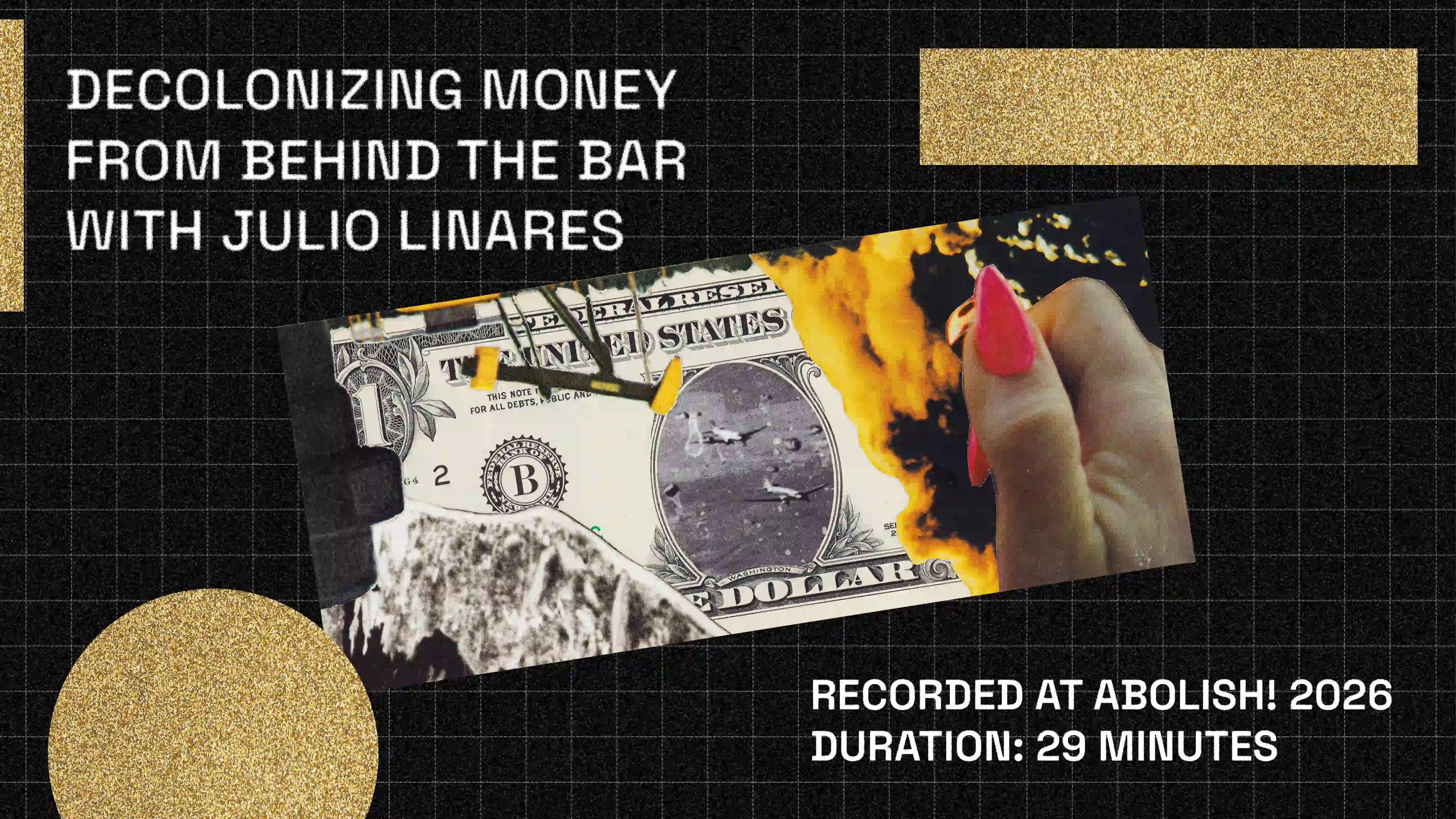
Decolonizing Money from Behind the Bar

WeSmellGas, Julio Linares

2026

PLATFORMS

On RSS

On Apple Podcast

On Pocket Casts

CONVERSATION SERIES

Listen to organisers and thinkers sharing their experiences and perspectives. Focusing on struggles and learnings crucial for our social movements at this time, these in-depth exchanges allow you to discover new topics and dive deeper into what matters.

ABOUT THIS EPISODE

What would a world without the U.S. petrodollar look like, feel like, smell like? Rooted in abolitionist, anti-colonial and anarchist thinking, Julio Linares takes us from the counter of a community bar onto a journey across debt cancellation, community-owned solar currencies and the burning of dollar bills.

SPEAKERS

Julio César Linares is a community organizer and economic anthropologist born in the territories known today as Guatemala. He holds an MSc from the London School of Economics where he studied and worked on projects with the late David Graeber. He serves as Public Outreach for the Basic Income Earth Network (BIEN). He lives in Berlin, Germany.

RESOURCES

All used resources and much more can be found on the Resource Library. This is a digital multi-media library to share resources on energy, extractivism, imperialism and collective liberation.

TRANSCRIPT

INTRODUCTION

WeSmellGas:

Welcome to "Decolonizing Money from behind the bar", a podcast episode by WeSmellGas Collective. This episode was recorded at the 2026 Abolish festival in Bern, Switzerland, on an occupied trailer park on the outskirts of the city. We are with Julio Linares, economic anthropologist and community organiser from the territories known today as Guatemala. After giving a workshop, we are at the community bar where Julio takes on a shift serving drinks to comrades and local inhabitants – a perfect moment to dive into Julio's work on abolishing the petrodollar and more broadly, how to decolonise money.

AT THE BAR
Julio (German):

Are you paying with Twint or in cash? Oh, I love cash.

MEETING JULIO

Julio (English):

So I'm Julio, I'm originally from Guatemala. I lived there until I was 19 and then I migrated. I lived in Asia for six years and then moved to Europe. I've been in Europe for about eight, nine years now and I do many things with regards to activism or community organising.

In Berlin, with many friends, we started a place called Offline, which is a self-organised space that many collectives use just to make their events, it's basically an open calendar. People can just sign up for it as long as they're pro-Palestine, anti-colonial and, you know,  have some sort of collective self-organisation thing going on. So that's been going on for like three years now, which is really nice.

But then I'm also part of many migrant collectives in Berlin. I have a band, a punk band. It's called Bêrîtan, named after the Kurdish guerrilla that was once, I think in 1994, basically getting attacked by the Turkish forces and also the Peshmerga. And so that they didn't take her weapon and her body, she jumped from a cliff. In her name we call the band Bêrîtan.

I've been for many years in touch with the Kurdish movement, learned a lot from them. And I think our band is kind of a way to express a lot of the things that go on in our territories, but that are sort of connected to struggles in places like Kurdistan or Palestine.

AT THE BAR

Julio:

Hey, do you want a drink?

Visitor: Yes, may I have a syrup, with sparkling water.

Julio: Wow, sure. Let's see.

Visitor: I left my money at the entrance. Is it ok if I can pay later.

Julio: Yeah, only we will charge an interest though. No, just kidding, don't worry.

FROM UNIVERSAL BASIC INCOME TO ABOLISHING THE DOLLAR

Julio:

So I was saying, I'm involved with a lot of movements that deal with money stuff. So Debt Cancellation is one of them, through Debt for Climate, which is a collective that I was part of at the beginning when it was starting and now I'm coming back to.

Also the Basic Income movement, I'm part of it took a volunteer run organisation called the Basic Income Earth Network. It's been going on for like 30 years and we do congresses every year in different parts of the world about basic income. And I serve as public outreach for the network, so my job is basically to go around and promote basic income everywhere I go.

So I've been part of making a Latin American-wide basic income network, creating local chapters in different countries and trying to make basic income pilots at the communitarian level. Right now we're trying to work with communities in Brazil, in Peru, in Guatemala to  make it at the more communitarian level. So thinking about forms of local economic democracy beyond the nation state. It's kind of the trip I'm currently into. So that's more like on the practise side of things.

I'm also an economic anthropologist and I just wrote a book, it's called Decolonising Money, and it's an argument of why we have to abolish the US dollar. There is a very strong mix of anarchist thinking, anarchist practises with anti-colonial and anti-imperialist thought. So the traditions I try to draw on and mix together in the book to argue what does it mean to decolonise money, deals a lot with the work we were doing yesterday at the workshop about abolition and abolitionism.

So drawing on the Black radical tradition about the abolition of prisons and how to create structures of care that replace these oppressive structures. I try to apply these arguments to money to argue why we have to first abolish these institutions of power, like monetary institutions like the Federal Reserve, the US Treasury, central banks etc., but also create counter institutions.

Then I also draw a lot on the work of like Frantz Fanon and other people that have thought a lot about what does decolonisation actually mean in practise? And there I have to say that over the recent years, unfortunately, decolonisation has been really misused by a lot of academics in the north of the world, European academics, US academics that have sort of taken away a lot of the radical meaning of it that it originally had. So I think it's important to think about the decolonisation of money alongside questions of Land Back – distribution of land – and really just like as Fanon said, complete transformation of the world.

And so today we live in a world where in some countries people have some sense of a little bit of political democracy, and it's of course like a liberal representative democracy, it's not like a radical kind of democracy, but there is no economic democracy at all. We just live under a dictatorship of capital. So I think that process of decolonisation of money necessarily involves abolition of institutions and then the creation of new ones.

I try to think about these things from an anti-state perspective and anti-capitalist perspective. So how can we create structures of governance similar to how, for example, the PKK and the YPG have done in places like Kurdistan, or the Zapatistas have done in Chiapas? How could we create economic structures at the local level that can be federated and confederated at the global level as well to coordinate things around the economy?

I have all these mixed traditions in the book and I try to synthesise them somehow. But yeah, I didn't write this book in academia, I wrote it outside to activists, to people interested in actually trying to change the world.

So the book, actually, I would say, is an attempt at a synthesis I did of a series of conversations that were started by people before me. So these ideas are not just my own. It comes out of a group that a former teacher and friend, comrade David Graeber, made, called SPECTRE. One of the running jokes for SPECTRE's name was that it meant the Secret Political Economy Consortia for the Total Redistribution of Everything.

And basically it was like a way of convening different people, heterodox people, thinking about alternatives to capitalism and nation-states, alternatives in terms of "what could we do instead?" And so when I was writing this book I knew things about debt cancellation, basic income, like the alternatives, but when I started writing the book, I was not thinking about the abolition of the dollar. That kind of came as a conclusion in a way.

I thought: "Okay, what needs to happen in the world for these big changes to come about?" And I thought: "if the dollar were to fall, if we were to abolish it, then we could change that."

AT THE BAR

Julio (in German):

What do you want to drink? Mate?

WeSmellGas:

It's kind of amazing to see you, like, cash in, cash out during this interview.

Julio:

Yeah, it's big bills the Swiss have!

UNDERSTANDING THE PETRODOLLAR

Julio:

Last year, as I was finishing the book, I started making this joke to friends that I hope by the time my book comes out, the dollar is still around. So it's still sort of relevant, you know?

Because it feels like there is some sort of accelerationism in how the U.S. empire is going down. I name a lot of those things in the book, how the U.S. dollar is going against itself, how the Trump administration is going against its own sort of political economic interests for whatever reason. And yeah, it's kind of crazy now that before the war in Iran, no one even heard about things like the Strait of Hormuz and all these dynamics of how the system is actually organised through the petrodollar.

And so definitely, I think it's really important that it's coming out now so people can also learn about, for example, in the climate movement. I always felt that there wasn't really coming to terms with these systems. It was more like "Climate change is bad, let's change it, let's go against fossil fuels!" But then the actual mechanisms were not so clear.

I hope my contribution is to remind people of how these things are actually arranged so we can think about strategies and tactics to undermine them.

WeSmellGas:

So diving a little bit more into the petrodollar specifically, could you quickly explain what the petrodollar is and how it operates today?

Julio:

Yeah, so the petrodollar is basically an agreement, a patriarchal pact made between different groups of people. It started in 1974 when – I think it was Kissinger, one of the main architects of it – basically the U.S. Treasury officials made a deal with the Saudi Arabian elite government to basically price all oil in dollars. And the context of it is that the year before there was the October War, what Israelis call the Yom Kippur War, but basically it was a moment where, as a consequence of this, the Arab nations that produce oil started doing a whole attack against all state supporting in Israel. So the price of oil really went up.

This was a moment also when the U.S. was fighting a war with Vietnam. It had just changed the gold standard and made the dollar the reserve currency of the world. And so the U.S. was in a moment of crisis and they thought about this scheme to keep themselves in power.

This system has been going on since then, where now all oil-producing countries are basically semi-forced to sell their oil in dollars. If not, they get invaded or they get attacked, as it happened with Venezuela. Like, Maduro started pricing oil, I think, like in the U.N., in the Chinese U.N., in like 2017 or something, 2018. Iran, obviously, it's a big one as well.

The petroleum is an agreement where oil is priced only in dollars, enforced by the U.S. Army with the promise that the countries that give their money, their dollars that are sold in oil, they can get more dollars in the future, basically. There is this thing called U.S. Treasury bills, or U.S. Treasury IOUs, which are basically that: they're promises of future dollars. So, when investors want to have a "safe asset" to invest on, traditionally, U.S. Treasury bills are considered to be the safest asset under the heavens because the U.S. state guarantees that they will give anyone who invests their dollars with them to get more dollars.

But that is slowly starting to change, obviously. For example, in 2024, the Chinese government issued their own form of a U.S. Treasury bill, like made in China, and they sold it to the Saudi government on the eve of Trump's inauguration. And I think that was like a way to say, like, listen, you no longer control your own financial system anymore.

So, things are slowly beginning to shift. Slowly, but then surely and rapidly. The unimaginable is now becoming inevitable, which is kind of an interesting moment.

WeSmellGas:

So, what are the key actors and institutions that keep this petrodollar system in place at the moment?

Julio:

It's a lot of them, I would say, but I think the key ones are definitely on the producer's side, the oil-producing nations. We see now with the war in Iran, how Iran is attacking a lot of the oil and energy infrastructure of the Gulf nations, because that's really literally where a lot of the petrodollar strength comes from. There's also the U.S. Army, which is meant to defend the petrodollar. And yesterday, I made this metaphor where I said that the U.S. Army is like a dragon that needs oil in order to survive. And so, the U.S. Army is actually one of the biggest consumers of fossil fuels today, so it defends the same system that it depends on.

It's also part of the reason what drives things like climate change, obviously, economic growth, all these things are underpinned by this drive for endless extraction of oil and energy. Of course the U.S. Treasury, the Federal Reserve, like the U.S. monetary institutions are also part of this scheme. That's just some of them, just to name a few.

It's really crazy when you start to think about the effects that this has on everyday normal people. Because it's not just oil, right? It's everything that oil depends on. So, things like fertilisers. Farmers, for example, in Central America have huge surges in their prices because of wars that happen elsewhere that are driven by the petrodollar. And so, the cost of production of basic things like food goes up a lot and farmers are driven into debt, privatisation, there's a lot of suicides, of course, in different countries that farmers go through because of all these dynamics of commodity traders and so on. So, for example, there is a big one.

In Europe we saw with the interest of the U.S. to sell their energy to Europeans, they can go as far as destroying pipelines, directly going against other empires like Russia to basically ensure that they become the monopoly provider of things like LNG, liquefied natural gas. And that fucks over lots of working class people in Europe as well, who have to pay for the price of the now more expensive energy that they have to basically import from the U.S. So it's like this whole system of economic dependence that the U.S. has managed to create all over the world, right? So, those are some examples.

WeSmellGas:

And on the environment?

Julio:

On the environment, it's really the fact that, even though today we have already energy alternatives like solar and wind, the political will of the elite to keep fossil fuels going because of the petrodollar system or through the petrodollar system just perpetrates climate change. Because fossil fuels extraction is still one of the biggest causes of CO2 emissions and also climate change.

So long as we don't break with that system, we just have a feedback loop that will continue to keep growing. I think in 2024, we peaked the amount of barrels of oil that we've ever produced. And that just keeps on going.

This thing we call economic growth, that the degrowth people are always going on about, is fundamentally tied to fossil capital and fossil fuels. Unless we unlink from this, we won't be able to really change the course of where we're going. Species extinction, massive events like this, destruction of entire ecosystems, ways of life, people's lives, cultures, everything... It's all going to shit because of a few elite that want more money fuelled by oil.

And there are already alternatives, obviously. It's just that they are not structurally viable yet because of the subsidy and the political will that those who want to maintain the system in place continue to have.

LIVING ALTERNATIVES

Julio:

Some of the most interesting experiences that I've seen so far as living alternatives right now is in places like Brazil, for example, there is a very vibrant unconditional basic income movement that comes out of the Labour Party, the Workers' Party. So, the PT [Partido de los Trabajadores] at different local levels has managed to create municipal currencies that they give to people as a basic income, especially during the pandemic. So, they redistribute money that they get from other revenues, actually through oil, which is an interesting contradiction, and then give it to people as a basic income.

And so if we were not dependent on all this sort of oil economy, there could be ways of redistributing wealth in many different ways and give it to people as a basic income. So, I definitely think this sort of municipalist, local currency, like, bioregional currency ideas are good because people can then have different monies for different purposes, you know, that they can use and exchange and, you know, can be for recycling.

For example, when I was in Brazil recently, I went to visit the Banco Palmas, who invited me to go and check out what they do. And it's basically a bank that was started in the favela, and it's community-owned, it's a not-for-profit that basically issues people credits for production. They call it "solar money", so they have their own solar panels. And they have the solar currency that also circulates within their communities. So, now they serve over 300,000 people in Brazil.

In the north of South Korea, in a region called Gyeonggi, the now president of South Korea – before he was the governor – implemented a basic income pilot there. A system for the youth that are up to 24 years old that has also expanded to farmers and so on. That's one of the biggest schemes so far when it comes to actual living basic income experiences.

Things like debt cancellation are important. I hope that if we manage to abolish the US dollar, then a lot of the debts denominated in dollars will be cancelled as a consequence, which will free up a lot of wealth that today countries tribute to the empire, and that wealth then can be used for infrastructure, technological change, and so on.

That's, to me, the way to go: confederation of different types of local currencies, mutual credit systems, credit clearing system. Basically, we should get to a point where we don't need to use money anymore.

AT THE BAR

Julio:

Your coffee is "unterwegs".

ABOUT BURNING MONEY

WeSmellGas:

In your book, you speak about the money burning ritual, which is also something we did yesterday. Can you tell us a bit more about it and what it means for you?

Julio:

Yeah, I think I, in collective settings, I do it as a way to talk about money, not in a theoretical sense, because I feel like there's a lot of mysticism and academicism that goes on when it comes to money. And I find it very problematic because it's not really embodied. We use money all the time, and we're so alienated by it. But then we never really have a chance to speak about it from the gut, you know, from the heart, how it feels and what it does to us. And so, I think the fire is a very good ally in this process because it transgresses something in people's minds and bodies about what money is and where wealth comes from, what value is, these kind of questions.

I've done money burning rituals with very, very different groups all around, and it's always very different how people react and their stories, their memories, their traumas regarding money.

For me, personally, it's a bit of... I don't have a better term for it, but I call it an anarchist spiritual practise, because it allows me to sort of claim power over this object that is supposed to rule over me. And say: "No, I don't agree with this system, I don't want this system, the system does not define me. My creativity, my value as a human being, this money doesn't control or value life." I think it's like a way of inverting the power of this fetish somehow.

That's the call I have in the book, to get people to claim the power to destroy it, to destroy the dollar. As we were saying yesterday, from an anti-colonial perspective, the power to destroy is also a creative act, and I think that's really the imagination and the practise that I would like people to get away with.

THE RITUAL

Julio:

Okay, so it's very lovely to start a money burning ritual with this nice piano in the background.

All right, so I'm gonna pass you all a dollar, I want you to smell it, I want you to touch it, I want you to feel it, and tell me slowly, slowly, what you see, what you feel.

It's a very distinct smell, no? Very few things smell like this.

It's important to say that whatever emotions come, they're all welcome. Whatever you feel, just notice as this thing burns, what comes in you.

So, may the empire burn!

AFTERWORD

Julio:

I think we are living in a moment of total multi-level crisis and collapse in many ways, and I think many people see what's going on, you know, genocides, ecocides, all sorts of death and violence is growing in the world, and I think often people feel a sense of hopelessness, and I want to say to people that: this will also pass.

These structures of oppression, patriarchal capitalism, however you want to call it, the way it dies is very violent. And if we look at it from a long historical perspective, we're just witnessing the death of a specific mode in which states have organised life, and I think we are at the verge of something entirely radically new, so we just need to be patient and keep organising basically.

OUTRO

WeSmellGas:

Thank you for listening to this podcast by WeSmellGas. Julio's book has just come out with Pluto press, and dives  deeper into many of the topics we have touched upon here, as well as giving you a little guide on how to perform a money burning ritual yourself.

You can find all the references to this episode and much more on our Resource Library at wesmellgas.org/library. This is a digital, multi-language multi-media library with resources on energy, extractivism, imperialism and collective liberation. If you want to get involved in some way, including helping us translate some of our content into different languages, please get in touch at collective@wesmellgas.org.

Decolonizing Money from Behind the Bar

PLATFORMS

On RSS

On Apple Podcast

On Pocket Casts

CONVERSATION SERIES

Listen to organisers and thinkers sharing their experiences and perspectives. Focusing on struggles and learnings crucial for our social movements at this time, these in-depth exchanges allow you to discover new topics and dive deeper into what matters.

ABOUT THIS EPISODE

What would a world without the U.S. petrodollar look like, feel like, smell like? Rooted in abolitionist, anti-colonial and anarchist thinking, Julio Linares takes us from the counter of a community bar onto a journey across debt cancellation, community-owned solar currencies and the burning of dollar bills.

SPEAKERS

Julio César Linares is a community organizer and economic anthropologist born in the territories known today as Guatemala. He holds an MSc from the London School of Economics where he studied and worked on projects with the late David Graeber. He serves as Public Outreach for the Basic Income Earth Network (BIEN). He lives in Berlin, Germany.

RESOURCES

All used resources and much more can be found on the Resource Library. This is a digital multi-media library to share resources on energy, extractivism, imperialism and collective liberation.

TRANSCRIPT

INTRODUCTION

WeSmellGas:

Welcome to "Decolonizing Money from behind the bar", a podcast episode by WeSmellGas Collective. This episode was recorded at the 2026 Abolish festival in Bern, Switzerland, on an occupied trailer park on the outskirts of the city. We are with Julio Linares, economic anthropologist and community organiser from the territories known today as Guatemala. After giving a workshop, we are at the community bar where Julio takes on a shift serving drinks to comrades and local inhabitants – a perfect moment to dive into Julio's work on abolishing the petrodollar and more broadly, how to decolonise money.

AT THE BAR
Julio (German):

Are you paying with Twint or in cash? Oh, I love cash.

MEETING JULIO

Julio (English):

So I'm Julio, I'm originally from Guatemala. I lived there until I was 19 and then I migrated. I lived in Asia for six years and then moved to Europe. I've been in Europe for about eight, nine years now and I do many things with regards to activism or community organising.

In Berlin, with many friends, we started a place called Offline, which is a self-organised space that many collectives use just to make their events, it's basically an open calendar. People can just sign up for it as long as they're pro-Palestine, anti-colonial and, you know,  have some sort of collective self-organisation thing going on. So that's been going on for like three years now, which is really nice.

But then I'm also part of many migrant collectives in Berlin. I have a band, a punk band. It's called Bêrîtan, named after the Kurdish guerrilla that was once, I think in 1994, basically getting attacked by the Turkish forces and also the Peshmerga. And so that they didn't take her weapon and her body, she jumped from a cliff. In her name we call the band Bêrîtan.

I've been for many years in touch with the Kurdish movement, learned a lot from them. And I think our band is kind of a way to express a lot of the things that go on in our territories, but that are sort of connected to struggles in places like Kurdistan or Palestine.

AT THE BAR

Julio:

Hey, do you want a drink?

Visitor: Yes, may I have a syrup, with sparkling water.

Julio: Wow, sure. Let's see.

Visitor: I left my money at the entrance. Is it ok if I can pay later.

Julio: Yeah, only we will charge an interest though. No, just kidding, don't worry.

FROM UNIVERSAL BASIC INCOME TO ABOLISHING THE DOLLAR

Julio:

So I was saying, I'm involved with a lot of movements that deal with money stuff. So Debt Cancellation is one of them, through Debt for Climate, which is a collective that I was part of at the beginning when it was starting and now I'm coming back to.

Also the Basic Income movement, I'm part of it took a volunteer run organisation called the Basic Income Earth Network. It's been going on for like 30 years and we do congresses every year in different parts of the world about basic income. And I serve as public outreach for the network, so my job is basically to go around and promote basic income everywhere I go.

So I've been part of making a Latin American-wide basic income network, creating local chapters in different countries and trying to make basic income pilots at the communitarian level. Right now we're trying to work with communities in Brazil, in Peru, in Guatemala to  make it at the more communitarian level. So thinking about forms of local economic democracy beyond the nation state. It's kind of the trip I'm currently into. So that's more like on the practise side of things.

I'm also an economic anthropologist and I just wrote a book, it's called Decolonising Money, and it's an argument of why we have to abolish the US dollar. There is a very strong mix of anarchist thinking, anarchist practises with anti-colonial and anti-imperialist thought. So the traditions I try to draw on and mix together in the book to argue what does it mean to decolonise money, deals a lot with the work we were doing yesterday at the workshop about abolition and abolitionism.

So drawing on the Black radical tradition about the abolition of prisons and how to create structures of care that replace these oppressive structures. I try to apply these arguments to money to argue why we have to first abolish these institutions of power, like monetary institutions like the Federal Reserve, the US Treasury, central banks etc., but also create counter institutions.

Then I also draw a lot on the work of like Frantz Fanon and other people that have thought a lot about what does decolonisation actually mean in practise? And there I have to say that over the recent years, unfortunately, decolonisation has been really misused by a lot of academics in the north of the world, European academics, US academics that have sort of taken away a lot of the radical meaning of it that it originally had. So I think it's important to think about the decolonisation of money alongside questions of Land Back – distribution of land – and really just like as Fanon said, complete transformation of the world.

And so today we live in a world where in some countries people have some sense of a little bit of political democracy, and it's of course like a liberal representative democracy, it's not like a radical kind of democracy, but there is no economic democracy at all. We just live under a dictatorship of capital. So I think that process of decolonisation of money necessarily involves abolition of institutions and then the creation of new ones.

I try to think about these things from an anti-state perspective and anti-capitalist perspective. So how can we create structures of governance similar to how, for example, the PKK and the YPG have done in places like Kurdistan, or the Zapatistas have done in Chiapas? How could we create economic structures at the local level that can be federated and confederated at the global level as well to coordinate things around the economy?

I have all these mixed traditions in the book and I try to synthesise them somehow. But yeah, I didn't write this book in academia, I wrote it outside to activists, to people interested in actually trying to change the world.

So the book, actually, I would say, is an attempt at a synthesis I did of a series of conversations that were started by people before me. So these ideas are not just my own. It comes out of a group that a former teacher and friend, comrade David Graeber, made, called SPECTRE. One of the running jokes for SPECTRE's name was that it meant the Secret Political Economy Consortia for the Total Redistribution of Everything.

And basically it was like a way of convening different people, heterodox people, thinking about alternatives to capitalism and nation-states, alternatives in terms of "what could we do instead?" And so when I was writing this book I knew things about debt cancellation, basic income, like the alternatives, but when I started writing the book, I was not thinking about the abolition of the dollar. That kind of came as a conclusion in a way.

I thought: "Okay, what needs to happen in the world for these big changes to come about?" And I thought: "if the dollar were to fall, if we were to abolish it, then we could change that."

AT THE BAR

Julio (in German):

What do you want to drink? Mate?

WeSmellGas:

It's kind of amazing to see you, like, cash in, cash out during this interview.

Julio:

Yeah, it's big bills the Swiss have!

UNDERSTANDING THE PETRODOLLAR

Julio:

Last year, as I was finishing the book, I started making this joke to friends that I hope by the time my book comes out, the dollar is still around. So it's still sort of relevant, you know?

Because it feels like there is some sort of accelerationism in how the U.S. empire is going down. I name a lot of those things in the book, how the U.S. dollar is going against itself, how the Trump administration is going against its own sort of political economic interests for whatever reason. And yeah, it's kind of crazy now that before the war in Iran, no one even heard about things like the Strait of Hormuz and all these dynamics of how the system is actually organised through the petrodollar.

And so definitely, I think it's really important that it's coming out now so people can also learn about, for example, in the climate movement. I always felt that there wasn't really coming to terms with these systems. It was more like "Climate change is bad, let's change it, let's go against fossil fuels!" But then the actual mechanisms were not so clear.

I hope my contribution is to remind people of how these things are actually arranged so we can think about strategies and tactics to undermine them.

WeSmellGas:

So diving a little bit more into the petrodollar specifically, could you quickly explain what the petrodollar is and how it operates today?

Julio:

Yeah, so the petrodollar is basically an agreement, a patriarchal pact made between different groups of people. It started in 1974 when – I think it was Kissinger, one of the main architects of it – basically the U.S. Treasury officials made a deal with the Saudi Arabian elite government to basically price all oil in dollars. And the context of it is that the year before there was the October War, what Israelis call the Yom Kippur War, but basically it was a moment where, as a consequence of this, the Arab nations that produce oil started doing a whole attack against all state supporting in Israel. So the price of oil really went up.

This was a moment also when the U.S. was fighting a war with Vietnam. It had just changed the gold standard and made the dollar the reserve currency of the world. And so the U.S. was in a moment of crisis and they thought about this scheme to keep themselves in power.

This system has been going on since then, where now all oil-producing countries are basically semi-forced to sell their oil in dollars. If not, they get invaded or they get attacked, as it happened with Venezuela. Like, Maduro started pricing oil, I think, like in the U.N., in the Chinese U.N., in like 2017 or something, 2018. Iran, obviously, it's a big one as well.

The petroleum is an agreement where oil is priced only in dollars, enforced by the U.S. Army with the promise that the countries that give their money, their dollars that are sold in oil, they can get more dollars in the future, basically. There is this thing called U.S. Treasury bills, or U.S. Treasury IOUs, which are basically that: they're promises of future dollars. So, when investors want to have a "safe asset" to invest on, traditionally, U.S. Treasury bills are considered to be the safest asset under the heavens because the U.S. state guarantees that they will give anyone who invests their dollars with them to get more dollars.

But that is slowly starting to change, obviously. For example, in 2024, the Chinese government issued their own form of a U.S. Treasury bill, like made in China, and they sold it to the Saudi government on the eve of Trump's inauguration. And I think that was like a way to say, like, listen, you no longer control your own financial system anymore.

So, things are slowly beginning to shift. Slowly, but then surely and rapidly. The unimaginable is now becoming inevitable, which is kind of an interesting moment.

WeSmellGas:

So, what are the key actors and institutions that keep this petrodollar system in place at the moment?

Julio:

It's a lot of them, I would say, but I think the key ones are definitely on the producer's side, the oil-producing nations. We see now with the war in Iran, how Iran is attacking a lot of the oil and energy infrastructure of the Gulf nations, because that's really literally where a lot of the petrodollar strength comes from. There's also the U.S. Army, which is meant to defend the petrodollar. And yesterday, I made this metaphor where I said that the U.S. Army is like a dragon that needs oil in order to survive. And so, the U.S. Army is actually one of the biggest consumers of fossil fuels today, so it defends the same system that it depends on.

It's also part of the reason what drives things like climate change, obviously, economic growth, all these things are underpinned by this drive for endless extraction of oil and energy. Of course the U.S. Treasury, the Federal Reserve, like the U.S. monetary institutions are also part of this scheme. That's just some of them, just to name a few.

It's really crazy when you start to think about the effects that this has on everyday normal people. Because it's not just oil, right? It's everything that oil depends on. So, things like fertilisers. Farmers, for example, in Central America have huge surges in their prices because of wars that happen elsewhere that are driven by the petrodollar. And so, the cost of production of basic things like food goes up a lot and farmers are driven into debt, privatisation, there's a lot of suicides, of course, in different countries that farmers go through because of all these dynamics of commodity traders and so on. So, for example, there is a big one.

In Europe we saw with the interest of the U.S. to sell their energy to Europeans, they can go as far as destroying pipelines, directly going against other empires like Russia to basically ensure that they become the monopoly provider of things like LNG, liquefied natural gas. And that fucks over lots of working class people in Europe as well, who have to pay for the price of the now more expensive energy that they have to basically import from the U.S. So it's like this whole system of economic dependence that the U.S. has managed to create all over the world, right? So, those are some examples.

WeSmellGas:

And on the environment?

Julio:

On the environment, it's really the fact that, even though today we have already energy alternatives like solar and wind, the political will of the elite to keep fossil fuels going because of the petrodollar system or through the petrodollar system just perpetrates climate change. Because fossil fuels extraction is still one of the biggest causes of CO2 emissions and also climate change.

So long as we don't break with that system, we just have a feedback loop that will continue to keep growing. I think in 2024, we peaked the amount of barrels of oil that we've ever produced. And that just keeps on going.

This thing we call economic growth, that the degrowth people are always going on about, is fundamentally tied to fossil capital and fossil fuels. Unless we unlink from this, we won't be able to really change the course of where we're going. Species extinction, massive events like this, destruction of entire ecosystems, ways of life, people's lives, cultures, everything... It's all going to shit because of a few elite that want more money fuelled by oil.

And there are already alternatives, obviously. It's just that they are not structurally viable yet because of the subsidy and the political will that those who want to maintain the system in place continue to have.

LIVING ALTERNATIVES

Julio:

Some of the most interesting experiences that I've seen so far as living alternatives right now is in places like Brazil, for example, there is a very vibrant unconditional basic income movement that comes out of the Labour Party, the Workers' Party. So, the PT [Partido de los Trabajadores] at different local levels has managed to create municipal currencies that they give to people as a basic income, especially during the pandemic. So, they redistribute money that they get from other revenues, actually through oil, which is an interesting contradiction, and then give it to people as a basic income.

And so if we were not dependent on all this sort of oil economy, there could be ways of redistributing wealth in many different ways and give it to people as a basic income. So, I definitely think this sort of municipalist, local currency, like, bioregional currency ideas are good because people can then have different monies for different purposes, you know, that they can use and exchange and, you know, can be for recycling.

For example, when I was in Brazil recently, I went to visit the Banco Palmas, who invited me to go and check out what they do. And it's basically a bank that was started in the favela, and it's community-owned, it's a not-for-profit that basically issues people credits for production. They call it "solar money", so they have their own solar panels. And they have the solar currency that also circulates within their communities. So, now they serve over 300,000 people in Brazil.

In the north of South Korea, in a region called Gyeonggi, the now president of South Korea – before he was the governor – implemented a basic income pilot there. A system for the youth that are up to 24 years old that has also expanded to farmers and so on. That's one of the biggest schemes so far when it comes to actual living basic income experiences.

Things like debt cancellation are important. I hope that if we manage to abolish the US dollar, then a lot of the debts denominated in dollars will be cancelled as a consequence, which will free up a lot of wealth that today countries tribute to the empire, and that wealth then can be used for infrastructure, technological change, and so on.

That's, to me, the way to go: confederation of different types of local currencies, mutual credit systems, credit clearing system. Basically, we should get to a point where we don't need to use money anymore.

AT THE BAR

Julio:

Your coffee is "unterwegs".

ABOUT BURNING MONEY

WeSmellGas:

In your book, you speak about the money burning ritual, which is also something we did yesterday. Can you tell us a bit more about it and what it means for you?

Julio:

Yeah, I think I, in collective settings, I do it as a way to talk about money, not in a theoretical sense, because I feel like there's a lot of mysticism and academicism that goes on when it comes to money. And I find it very problematic because it's not really embodied. We use money all the time, and we're so alienated by it. But then we never really have a chance to speak about it from the gut, you know, from the heart, how it feels and what it does to us. And so, I think the fire is a very good ally in this process because it transgresses something in people's minds and bodies about what money is and where wealth comes from, what value is, these kind of questions.

I've done money burning rituals with very, very different groups all around, and it's always very different how people react and their stories, their memories, their traumas regarding money.

For me, personally, it's a bit of... I don't have a better term for it, but I call it an anarchist spiritual practise, because it allows me to sort of claim power over this object that is supposed to rule over me. And say: "No, I don't agree with this system, I don't want this system, the system does not define me. My creativity, my value as a human being, this money doesn't control or value life." I think it's like a way of inverting the power of this fetish somehow.

That's the call I have in the book, to get people to claim the power to destroy it, to destroy the dollar. As we were saying yesterday, from an anti-colonial perspective, the power to destroy is also a creative act, and I think that's really the imagination and the practise that I would like people to get away with.

THE RITUAL

Julio:

Okay, so it's very lovely to start a money burning ritual with this nice piano in the background.

All right, so I'm gonna pass you all a dollar, I want you to smell it, I want you to touch it, I want you to feel it, and tell me slowly, slowly, what you see, what you feel.

It's a very distinct smell, no? Very few things smell like this.

It's important to say that whatever emotions come, they're all welcome. Whatever you feel, just notice as this thing burns, what comes in you.

So, may the empire burn!

AFTERWORD

Julio:

I think we are living in a moment of total multi-level crisis and collapse in many ways, and I think many people see what's going on, you know, genocides, ecocides, all sorts of death and violence is growing in the world, and I think often people feel a sense of hopelessness, and I want to say to people that: this will also pass.

These structures of oppression, patriarchal capitalism, however you want to call it, the way it dies is very violent. And if we look at it from a long historical perspective, we're just witnessing the death of a specific mode in which states have organised life, and I think we are at the verge of something entirely radically new, so we just need to be patient and keep organising basically.

OUTRO

WeSmellGas:

Thank you for listening to this podcast by WeSmellGas. Julio's book has just come out with Pluto press, and dives  deeper into many of the topics we have touched upon here, as well as giving you a little guide on how to perform a money burning ritual yourself.

You can find all the references to this episode and much more on our Resource Library at wesmellgas.org/library. This is a digital, multi-language multi-media library with resources on energy, extractivism, imperialism and collective liberation. If you want to get involved in some way, including helping us translate some of our content into different languages, please get in touch at collective@wesmellgas.org.
Latest by We Smell Gas